
ASUS Dual Radeon RX 9060 XT
4.7Editor score
16GB GDDR6 memory
Axial-tech fan design
0dB silence technology
This guide compares the top graphics cards for ray tracing performance featuring NVIDIA Blackwell and AMD RDNA architectures for immersive gaming visuals.
Ray tracing technology has revolutionized how we experience interactive visuals by simulating light behavior for realistic shadows and reflections in modern gaming environments.
We evaluated ten leading graphics cards based on architecture efficiency cooling performance and rendering capabilities to help you find the right hardware for your setup.
Each selection highlights specific strengths and trade-offs while noting that pricing and availability fluctuate frequently so verify current details before making your final decision.
4.7Editor score

4.6Editor score

4.8Editor score
The following table provides a side-by-side comparison of all selected graphics cards highlighting their core specifications and cooling designs to facilitate easy selection.




This graphics card stands out as the top choice for enthusiasts seeking uncompromised ray tracing fidelity thanks to its advanced NVIDIA Blackwell architecture and DLSS 4 capabilities.
We may earn a commission when you buy through this link, at no additional cost to you.
The integration of 16GB of GDDR7 memory ensures that high resolution textures and complex lighting calculations are handled with minimal latency delivering smooth frame rates even in demanding titles.
While the card demands a powerful power supply and occupies significant space inside a case its thermal management via the WINDFORCE system keeps noise and heat levels within acceptable ranges under load.
For gamers prioritizing visual fidelity above all else this model offers the necessary horsepower to enable path tracing and advanced light effects without sacrificing performance in modern game engines.
The Blackwell architecture optimizes ray tracing cores to process light paths faster than previous generations enabling more realistic global illumination in real time scenarios.
With a 256-bit GDDR7 interface this card moves data at speeds that prevent bottlenecks when rendering high resolution assets and complex scene geometries efficiently.
We may earn a commission when you buy through this link, at no additional cost to you.
This Radeon based option provides a compelling alternative for those who want high quality ray tracing without stepping into the highest price brackets available in the current market.
We may earn a commission when you buy through this link, at no additional cost to you.
The WINDFORCE cooling system combined with Hawk Fans ensures that the GPU remains cool even during extended gaming sessions while the 16GB of memory supports modern game requirements comfortably.
While it may not match the absolute peak performance of the highest tier NVIDIA offerings it delivers consistent frame rates in titles that support accelerated path tracing effectively.
Buyers looking for a balance between cost and visual fidelity will find this card offers significant value with a design that fits well in standard enthusiast gaming setups.
Server grade thermal conductive gel and the WINDFORCE system work together to dissipate heat quickly allowing the card to boost clocks sustainably over long periods.
The 16GB GDDR6 capacity ensures that users can load high quality texture packs without running into memory limitations that could cause stuttering in open world games.
We may earn a commission when you buy through this link, at no additional cost to you.
The ASUS Prime model prioritizes acoustic comfort making it an ideal choice for users who prefer a quiet environment while still enjoying the benefits of hardware accelerated ray tracing effects.
We may earn a commission when you buy through this link, at no additional cost to you.
Its Axial-tech fans utilize a smaller hub and barrier ring to optimize air pressure which combined with 0dB technology allows the fans to stop completely during light gaming loads.
The inclusion of phase change thermal pads ensures efficient heat transfer from the GPU die to the cooler which helps maintain stable performance during demanding visual rendering tasks.
Those who value a cleaner look and quiet operation will appreciate the dual ball bearing design that offers longevity without sacrificing the cooling efficiency needed for ray tracing workloads.
The dual BIOS switch allows users to easily toggle between a quiet profile for daily use and a performance profile when maximum frame rates are required for specific titles.
Double ball fan bearings are designed to last up to twice as long as standard sleeve bearings ensuring that the card remains reliable over years of heavy usage.
We may earn a commission when you buy through this link, at no additional cost to you.
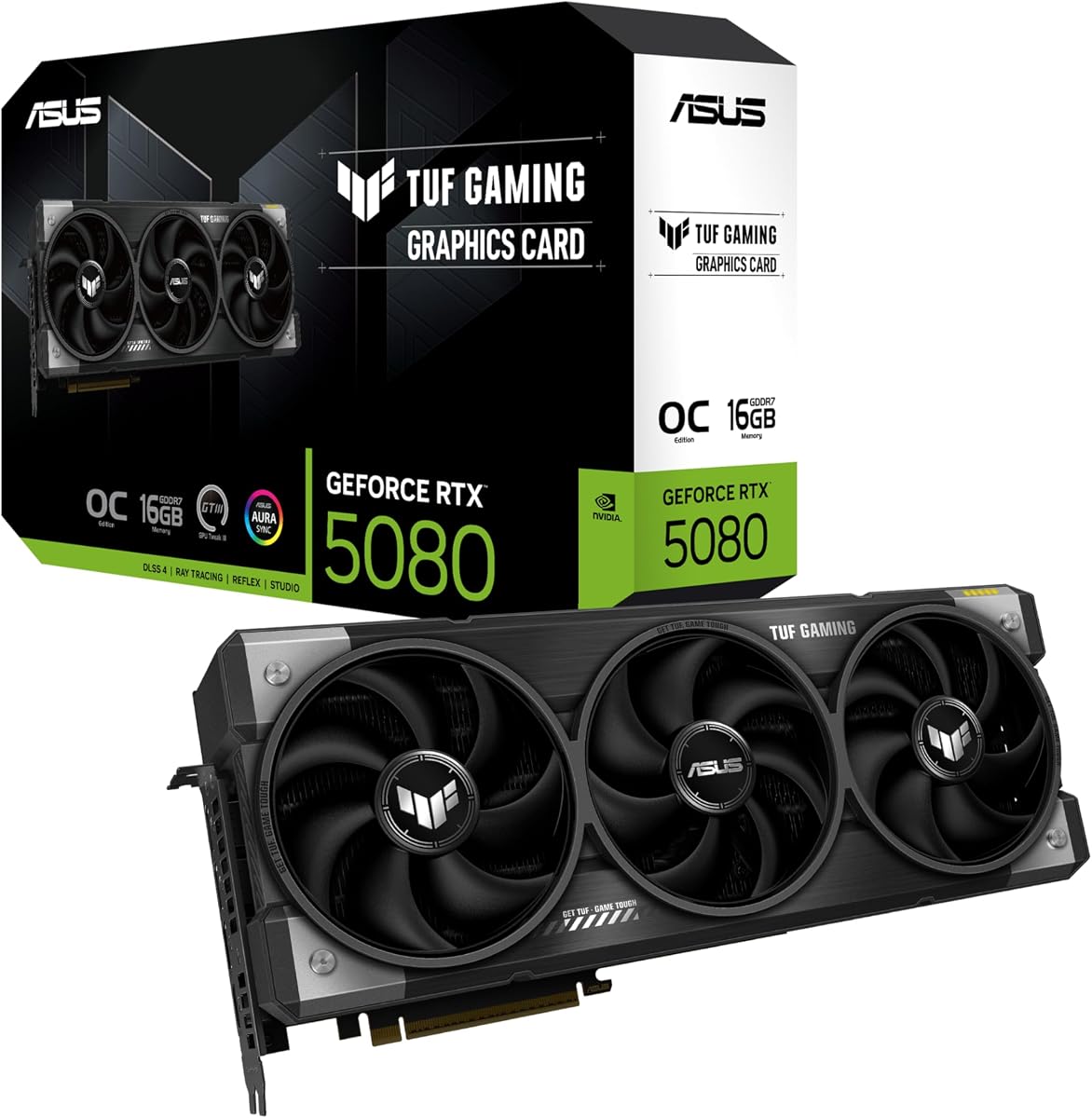
This TUF Gaming card is built with military grade components that deliver rock solid power delivery and longevity making it a robust choice for high end systems that see heavy daily use.
We may earn a commission when you buy through this link, at no additional cost to you.
The protective PCB coating guards against short circuits caused by moisture or dust which is particularly useful in environments where dust accumulation might be a concern for sensitive electronics.
With a massive fin array and three Axial-tech fans the cooling solution handles the heat generated by the RTX 5080 efficiently ensuring that thermal throttling does not impact ray tracing performance.
Gamers who want a card that is engineered for long term reliability and can withstand the demands of extended gaming sessions will find this model offers exceptional value and peace of mind.
Phase change thermal pads outlast traditional paste providing a stable thermal interface that ensures consistent cooling performance throughout the lifespan of the graphics card.
The Auto-Extreme precision automated manufacturing process ensures higher reliability by reducing human error during assembly and creating a more consistent final product for consumers.
We may earn a commission when you buy through this link, at no additional cost to you.
Designed with a 2.5 slot footprint this card maximizes compatibility and cooling efficiency making it an excellent choice for small form factor builds that still require ray tracing capabilities.
We may earn a commission when you buy through this link, at no additional cost to you.
The AI Performance rating of 767 TOPS indicates strong support for DLSS technologies which can significantly boost frame rates in games that utilize upscaling features for high resolution outputs.
While it does not have the massive cooling arrays of higher end cards the dual ball fan bearings and Axial-tech design provide sufficient thermal management for typical gaming scenarios.
Users building compact gaming rigs or needing a secondary card for streaming can rely on this model to deliver solid ray tracing performance without demanding excessive power or physical space.
The high AI Performance metric ensures that DLSS 4 can generate frames quickly maintaining smooth visuals even when ray tracing adds significant overhead to the rendering pipeline.
Dual BIOS functionality allows users to adjust fan curves and clock speeds based on their specific case airflow constraints ensuring flexibility in tuning the card for silent or fast performance.
We may earn a commission when you buy through this link, at no additional cost to you.
This mid range offering provides a balanced mix of performance and durability making it a reliable choice for builders who want ray tracing without spending on the highest tier models available.
We may earn a commission when you buy through this link, at no additional cost to you.
The military grade components deliver rock solid power and a longer lifespan ensuring that the card can handle the electrical demands of modern games without risk of premature component failure.
With a massive fin array optimized for airflow the card maintains low temperatures even when boosting clocks for ray tracing scenes which helps preserve the integrity of the silicon over time.
Gamers looking for a dependable card that fits well in a variety of cases will appreciate the consistent performance and the reliability features that ASUS has incorporated into this design.
The combination of military grade components and phase change thermal pads ensures that power delivery and heat dissipation remain stable even under sustained loads typical of ray tracing.
GPU Tweak III software provides intuitive performance tweaking and thermal control allowing users to monitor and adjust settings in real time for optimal system efficiency.
We may earn a commission when you buy through this link, at no additional cost to you.
As an accessible entry point into hardware accelerated ray tracing this card offers a 16GB memory buffer that helps modern games run smoothly without demanding a massive financial investment.
We may earn a commission when you buy through this link, at no additional cost to you.
The Axial-tech fans ensure that the card stays cool and quiet during normal use while the dual BIOS switch allows users to customize the fan behavior based on their noise tolerance levels.
While it may not handle the most extreme path tracing settings at native resolution it provides a solid baseline for enabling light effects in most popular gaming titles at reasonable settings.
Budget conscious gamers will find this model to be a practical solution that delivers real time ray tracing capabilities without requiring a complete overhaul of their existing PC components.
The 16GB of GDDR6 memory ensures that even budget cards can handle high resolution textures which helps prevent stuttering in open world titles that load large amounts of data.
0dB technology allows the fans to stop completely during light gaming loads ensuring that the system remains whisper quiet when running older or less demanding applications.
We may earn a commission when you buy through this link, at no additional cost to you.
This model represents a premium offering that combines high speed memory with robust cooling to deliver top tier ray tracing performance that can handle the most demanding visual settings available.
We may earn a commission when you buy through this link, at no additional cost to you.
The 16GB of GDDR7 memory ensures that future titles with high texture requirements will run without bottlenecks while the military grade components guarantee long term reliability for your investment.
With a massive fin array and optimized airflow the card manages heat effectively allowing the GPU to maintain high boost clocks even during extended sessions of ray tracing enabled gaming.
Gamers seeking the best balance between price and ultimate visual fidelity will find this card to be a compelling choice that offers high performance without stepping into the absolute top tier pricing.
The 16GB GDDR7 memory interface provides the bandwidth needed to handle complex scenes and high resolution textures ensuring smooth frame rates during ray tracing workloads.
Auto-Extreme precision automated manufacturing helps ensure higher reliability by reducing human error and creating a consistent high quality product that stands up to rigorous daily use.
We may earn a commission when you buy through this link, at no additional cost to you.
This card delivers strong performance for its class making it an excellent value for gamers who want to enable ray tracing features without compromising on frame rates in popular titles.
We may earn a commission when you buy through this link, at no additional cost to you.
The integration of 12GB of GDDR7 memory provides sufficient bandwidth for most modern games ensuring that textures and lighting calculations are processed quickly without noticeable lag.
Powered by the NVIDIA Blackwell architecture it supports DLSS 4 which enhances visual fidelity while keeping performance high during complex scenes that require heavy ray tracing calculations.
Players looking for a reliable option that balances cost with high performance will appreciate the efficient cooling system that keeps the card stable even during long gaming sessions.
The PCIe 5.0 interface ensures that the card is ready for future motherboard upgrades providing a bandwidth advantage that will be useful for upcoming high end game engines.
The WINDFORCE cooling system is designed to move air efficiently through the heatsink keeping the GPU at optimal temperatures for consistent performance during demanding workloads.
We may earn a commission when you buy through this link, at no additional cost to you.
This compact card delivers high end performance in a small package making it ideal for users who need powerful ray tracing capabilities in a small form factor gaming build.
We may earn a commission when you buy through this link, at no additional cost to you.
The IceStorm 2.0 advanced cooling system ensures that the GPU stays cool and quiet even when pushing the limits of its ray tracing capabilities in demanding gaming scenarios.
With support for DLSS 3 and full ray tracing the card offers a versatile experience that can scale up to high resolutions while maintaining smooth frame rates in most titles.
Gamers looking for a stylish and efficient card that fits in tight cases will appreciate the Spectra RGB lighting and the compact design that does not compromise on performance quality.
The IceStorm 2.0 cooling technology allows for a compact card to maintain high performance by efficiently managing heat with a design that is optimized for smaller cases.
Spectra RGB lighting adds a touch of personalization to the system allowing users to match the card with their case theme while keeping the overall aesthetic cohesive and modern.
We may earn a commission when you buy through this link, at no additional cost to you.
Selecting the right graphics card for ray tracing requires considering several key factors to ensure your system delivers smooth visuals without unnecessary compromise.
The number of dedicated ray tracing cores in the GPU significantly impacts how quickly the card can calculate complex lighting paths and reflections in real time.
Cards with more cores will generally deliver higher frame rates when ray tracing is enabled making them essential for high resolution gaming.
Ray tracing often requires large amounts of memory to store high quality textures and complex geometry data without causing bottlenecks in rendering.
Models with 16GB of GDDR7 or GDDR6X memory are better equipped to handle modern titles that use high resolution assets and lighting data.
Efficient cooling is critical because ray tracing generates significant heat that can lead to thermal throttling if the card cannot dissipate it effectively.
Look for cards with large fin arrays multiple fans and high quality thermal pads to maintain stable performance under heavy loads.
AI driven upscaling technologies like DLSS 4 can boost frame rates by generating frames between real renders allowing ray tracing to run smoother at high settings.
Ensure the card supports the latest versions of these technologies to get the best balance between visual fidelity and smooth gameplay performance.
High performance ray tracing cards often demand substantial power which means your power supply unit must be able to handle the load without risk of failure.
Verify that your PSU provides enough wattage and has the required connectors like 12VHPWR to support the chosen graphics card safely.
Larger cards with robust cooling systems can be quite long and occupy multiple expansion slots which may not fit in all standard gaming chassis.
Measure your case clearance and slot availability before purchasing to ensure the card will install properly without blocking other components.
Choosing a reputable brand with a strong warranty ensures that you will receive reliable customer support if any issues arise with the hardware over time.
Models with durable components and automated manufacturing processes tend to offer better long term reliability for demanding workloads like ray tracing.
Evaluate the cost of the card against its performance in ray tracing to determine if it offers the best value for your specific budget constraints.
Mid range options often provide excellent ray tracing performance without the extreme cost of top tier models for most gamers.
Install the card securely in the PCIe slot and connect all necessary power cables to ensure stable power delivery and prevent crashes during demanding ray tracing sessions.
Keep your GPU drivers updated to the latest version to benefit from performance optimizations and bug fixes that improve ray tracing compatibility across different games.
Maintain proper airflow in your case by cleaning dust filters regularly and using cable management to prevent airflow restrictions that could lead to higher temperatures.
Yes ray tracing generally reduces frame rates because it requires substantial computational power to calculate realistic light paths and reflections in real time. However modern DLSS and upscaling technologies help mitigate this by allowing games to render at lower resolutions and upscale them to maintain smooth performance while preserving visual fidelity.
More VRAM is highly beneficial for ray tracing because it allows the GPU to store larger textures and complex geometry data needed for high fidelity rendering without stuttering. Cards with 16GB of memory are better equipped to handle high resolution games that combine ray tracing with ultra texture settings.
Most high end ray tracing cards require a minimum power supply of 750W to 850W depending on the specific model and system components. Be sure to verify the connector requirements as newer cards often use 12VHPWR or 16-pin connectors that may need adapters.
AMD has implemented ray tracing on its Radeon RX 7000 series and newer which offers solid performance but generally falls slightly behind NVIDIA in pure ray tracing efficiency and DLSS adoption. However AMD cards provide competitive value for those prioritizing rasterization over pure ray tracing performance.
DLSS is crucial for ray tracing because it uses AI to generate frames or upscale images allowing the card to maintain smooth frame rates even when the workload of ray tracing is high. Without DLSS many users may experience significant drops in frame rates when enabling full ray tracing features.
You should measure the internal length of your case and the available expansion slots to ensure the card will fit without obstructing other components. Check the product specifications for exact dimensions including the number of slots it occupies to avoid installation issues.
The ten selected cards offer a wide range of options from budget friendly entries to premium powerhouses that handle the most demanding visual tasks in modern gaming.
When choosing prioritize your preferred resolution and desired frame rates while balancing the need for high VRAM and robust cooling to ensure long term reliability.
Always check current availability and verify your system compatibility before purchasing to ensure the card meets your specific needs for ray tracing performance.