
Siraya Tech Tenacious Highly Flexible
4.7Editor score
Soft rubber-like flexible resin
Enhanced elasticity and rebound
High impact resistance for durability
This guide compares the top flexible resins for 3D printing based on durability, flexibility, ease of use, and performance for various printing needs.
Flexible resin for 3D printing allows creators to produce parts with rubber-like properties that bend and absorb shock without breaking. These materials are essential for functional prototypes, gaskets, and wearables that require more than rigid plastic.
We evaluated ten leading flexible resins by examining their shore hardness, elongation at break, print speed, and post-processing requirements. Each product was assessed for compatibility with standard LCD and DLP printers and its ability to maintain structural integrity under stress.
Each pick highlights specific strengths such as impact resistance, low odor, or high precision. Keep in mind that pricing and availability fluctuate frequently, so verify current offers before making your final purchasing decision for your next project.
4.7Editor score
4.7Editor score
4.2Editor score
The following table provides a side-by-side comparison of all ten flexible resins, highlighting their key specifications such as shore hardness, weight, and primary use cases to help you quickly identify the right material for your specific 3D printing needs.



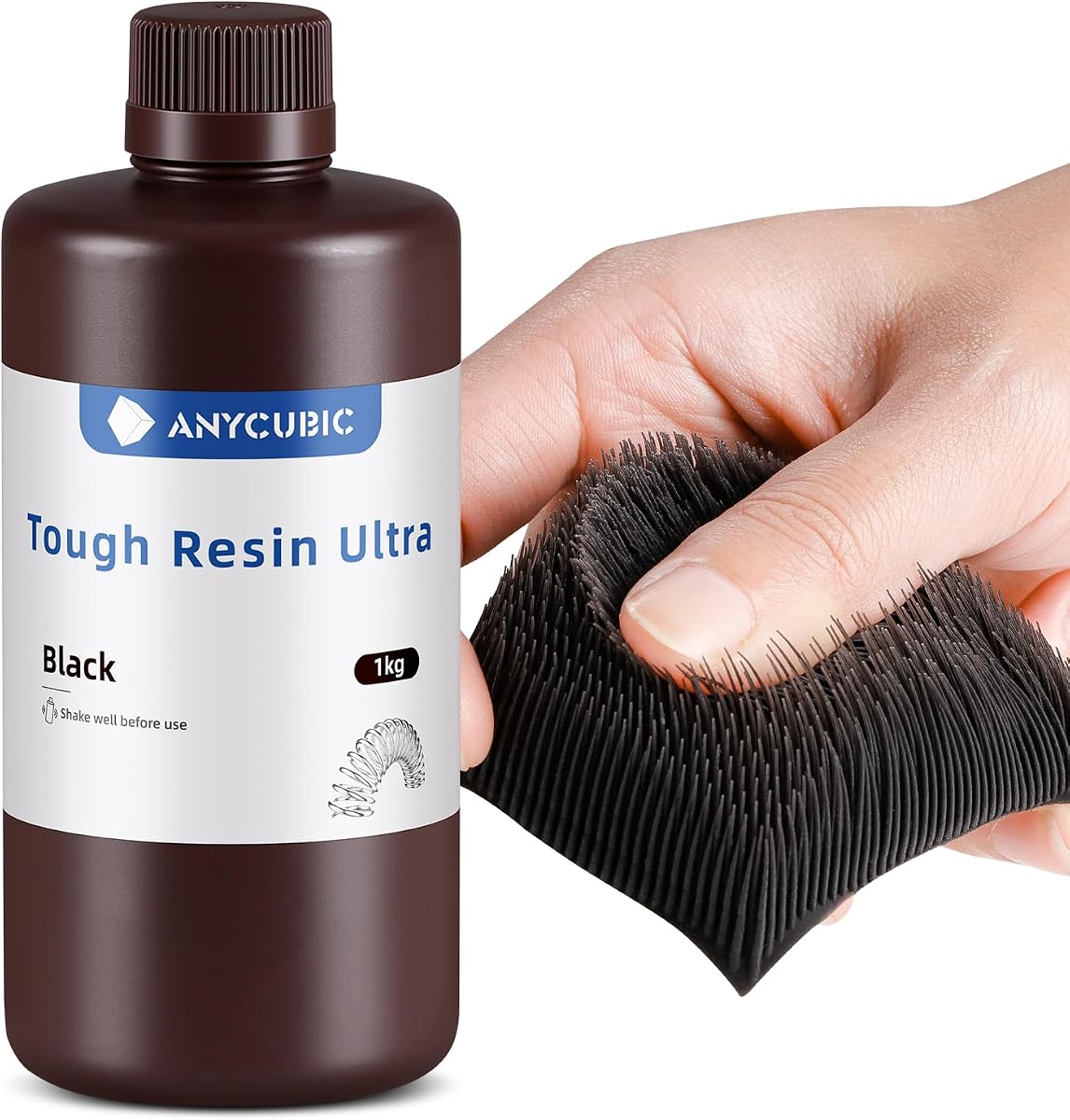
The ANYCUBIC Ultra Tough Resin stands out as a top contender in the flexible resin category. With a high rating and robust user feedback, it offers a perfect balance of flexibility and strength. Its unique formulation allows models to withstand deformation and recover quickly, making it ideal for functional parts.
We may earn a commission when you buy through this link, at no additional cost to you.
This resin excels in impact resistance and flexibility. It is tailored for creating articulated models with seamless movement. The material also ensures a non-irritating experience on the skin, making it suitable for wearable items like earphone covers. It remains stable even in high humidity or damp environments.
While it is versatile, mixing it with other resins might affect the final color if not carefully matched. Additionally, proper curing is necessary to ensure it passes safety standards. These trade-offs are generally acceptable given the performance benefits for most makers and engineers.
We recommend this resin for users needing durable, flexible parts that can endure stress. Whether you are prototyping or making daily wearables, its reliability makes it a solid choice. Always follow post-processing guidelines to maximize its performance and safety.
This resin quickly recovers its original shape after deformation, ensuring longevity and resilience in demanding applications.
It elevates clarity and sharpness in fine details, facilitating seamless movement and interchangeability of parts.
We may earn a commission when you buy through this link, at no additional cost to you.
Siraya Tech Tenacious Highly Flexible offers a significantly softer and more rubber-like feel compared to its classic counterpart. This formulation provides incredible elasticity, perfect for projects requiring dynamic movement. Its high rating reflects strong user satisfaction with its resilience and ease of use.
We may earn a commission when you buy through this link, at no additional cost to you.
The resin withstands extreme bending and compression, quickly returning to its original shape. It is designed to keep models resilient and protected against impacts. This makes it ideal for soft grips, gaskets, and shock-absorbing components. It can also be mixed with other resins to boost flexibility.
One trade-off is that it may not suit applications where the original Tenacious resin is typically used due to its softer nature. The 500g size might also require multiple bottles for larger projects. However, for flexible prototyping, these limits are minor compared to the benefits.
We suggest this resin for makers needing cost-effective flexibility. It is perfect for creating durable yet not brittle objects. If you need a reliable material for flexible parts, this is a strong budget-friendly option.
This new formulation offers faster rebound and incredible elasticity, allowing for more dynamic and flexible prints.
Ideal for projects requiring high flexibility such as soft grips and pliable prototypes.
We may earn a commission when you buy through this link, at no additional cost to you.
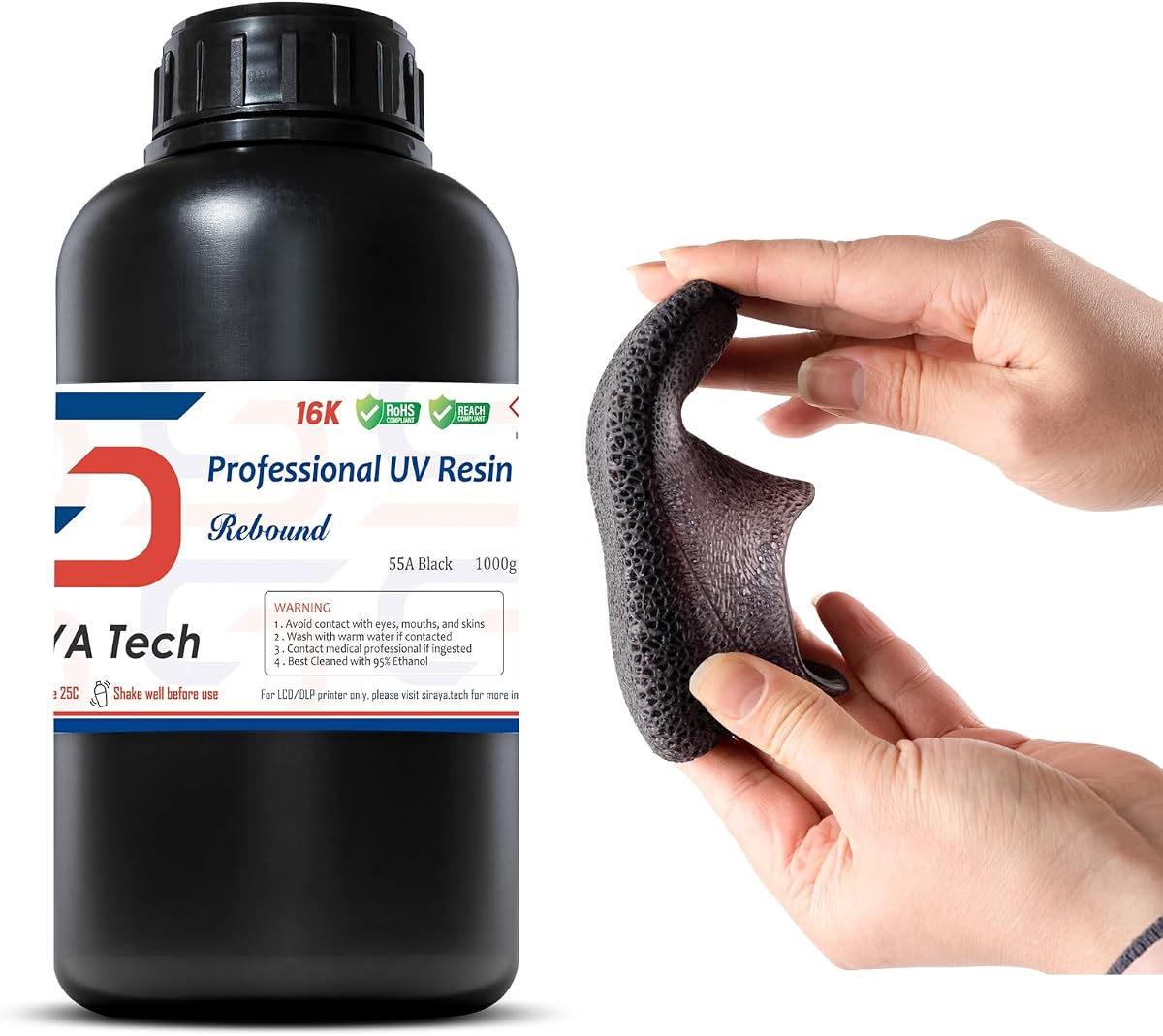
Siraya Tech Rebound 55A provides significantly faster rebound than standard elastic resins, making it excellent for impact absorption. With a 55A Shore hardness, it offers a balanced mix of flexibility and structural integrity. It is designed for prototyping components where quick shape recovery is crucial.
We may earn a commission when you buy through this link, at no additional cost to you.
Initial testing shows good resilience during compression cycles, maintaining elasticity over repeated use. Unlike other elastomers, it prints on standard LCD and DLP printers and cleans with standard isopropyl alcohol methods. This ease of use saves time and simplifies the workflow.
The main trade-off is that long-term performance testing is still ongoing. While initial results are promising, the higher price point reflects its premium nature. For professional prototyping where performance is paramount, these factors are often acceptable to users seeking top-tier results.
We recommend this for industrial prototyping and personal protective equipment where elasticity and rebound are key. It is well-suited for shock-absorbing components and consumer products. If you need reliable elasticity, this resin is a premium choice worth considering.
It provides significantly faster rebound than standard elastic resins for applications where quick shape recovery is needed.
Unlike other elastomers, it prints on standard LCD and DLP printers and cleans with standard methods.
We may earn a commission when you buy through this link, at no additional cost to you.
Superflex 3D Printer Resin is known for its fast printing capabilities, saving time and electricity on monochrome LCD printers. With an 80A Shore hardness and 100% elongation at break, it effectively simulates rubber or TPU for hard flexible prototypes. This makes it suitable for cushioning and damping.
We may earn a commission when you buy through this link, at no additional cost to you.
Its balanced softness and strength enhance productivity by up to 40%. The resin passes the ISO 10993-5 test when properly cleaned and cured. This certification ensures safety for many applications. Its clear version allows for easy inspection of the printed part.
The 500g size may be small for larger production runs. Additionally, it is only available in clear, limiting color options. However, for prototyping where speed and material properties are key, these drawbacks are minor. It remains a reliable choice for functional testing.
We suggest this for makers needing quick turnaround and specific rubber-like hardness. It is ideal for shock absorption prototypes. If you prioritize speed and safety standards, this resin offers great value and performance.
Prints 50um layers in 1.7 seconds, enhancing productivity on farms by at least 40%.
Simulates rubber or TPU for hard flexible prototypes with high elongation and shock absorption.
We may earn a commission when you buy through this link, at no additional cost to you.
SUNLU Flexible 3D Printer Resin offers a perfect balance of softness and strength, simulating rubber or durable prototypes. With a 70A Shore hardness and 135% elongation at break, it exhibits formidable strength and flexibility. It provides excellent impact resistance, allowing models to withstand drops.
We may earn a commission when you buy through this link, at no additional cost to you.
The resin has a low shrinkage rate, ensuring accurate size and shape of printed parts. It features a leak-proof bottle design to reduce damage during transportation. The aromatic odor is not pungent, making it comfortable for printing environments. It is compatible with 99% of printers.
With a lower rating compared to other options, it may not meet all expectations. The gray color might not be preferred for aesthetic models. However, for structural parts where precision and durability are key, it offers consistent performance. It is a practical choice for general use.
We recommend this for makers needing a reliable flexible resin for general printing. It is suitable for manufacturing most printing needs. If you value stability and low shrinkage, this is a solid option to consider.
Compatible with 99% of printers on the market including LCD, DLP and SLA.
Has a low shrinkage rate and minimal odor for accurate size and comfortable printing.
We may earn a commission when you buy through this link, at no additional cost to you.
ANYCUBIC Tough Resin 2.0 offers a comprehensive upgrade with enhanced toughness and high precision. It exhibits formidable strength and flexibility, effectively resisting peeling and stress marks. This makes it suitable for miniature components and thin models that are prone to breakage.
We may earn a commission when you buy through this link, at no additional cost to you.
The low-odor and non-irritating composition creates a comfortable printing environment. It maintains high precision with minimal shrinkage for crisp details. Compatible with most LCD resin printers, it is ideal for industrial spare parts and building models. Its formulation reduces volatile organic compounds.
The resin is optimized for wavelengths between 365nm and 405nm, which requires checking printer compatibility. The grey color may not fit all project needs. However, for high-strength model production, its reliability and precision stand out. It is a robust option for functional prototypes.
We suggest this for users needing durable and precise parts for industry use. It resists cyclic vibrations and drops. If you prioritize toughness and low odor, this resin delivers high value and consistency.
Demonstrates enhanced toughness making it less prone to fracture when printing miniature components.
Significantly reduces volatile organic compounds making it a green and environmentally friendly choice.
We may earn a commission when you buy through this link, at no additional cost to you.
SUNLU High Toughness 3D Printer Resin offers long-lasting toughness with elongation 5 times higher than regular standard resin. It has excellent flexibility and bendability, making models unbreakable and durable. This is very suitable for structural parts and solid models.
We may earn a commission when you buy through this link, at no additional cost to you.
The low viscosity and high flowability result in shorter curing time and easier model formation. With lower shrinkage, the potential for distortion is reduced. It also has lower printing odor for a comfortable environment. Compatible with most LCD/DLP/SLA printers.
The grey color limits aesthetic options but is practical for functional prototypes. It is designed to improve 3D printing success rate significantly. This resin is a strong choice for high toughness models. Its reliability is evident in user feedback.
We recommend this for makers needing durable structural parts. It reduces cracking after wash and curing. If you need accuracy and toughness, this is a solid option.
Low viscosity results in shorter curing time and easier model formation with reduced distortion.
Long-lasting toughness and elongation 5 times higher than regular standard resin for durable prints.
We may earn a commission when you buy through this link, at no additional cost to you.
ELEGOO Tough 3D Printer Resin has excellent flexibility and extraordinary resilience. It is easy to bend but not easy to break, with strong damage resistance. The cured resin has a Shore hardness of 84.7D, exceeding that of others in the category.
We may earn a commission when you buy through this link, at no additional cost to you.
It has high-strength physical properties and can withstand certain impacts. It is suitable for structural parts and tools. The fine texture shows excellent resistance to brittleness and corrosion even in high humidity. It ensures excellent performance under extreme temperature conditions.
The 84.7D hardness might be stiff for some flexible applications. The limited to black color restricts visual options. However, for high-performance models requiring durability, it offers great utility. It is easy to drill without cracks after curing.
We suggest this for end-use products and tools. It is a solid choice for parts needing high elasticity and flexibility. If you need robustness in extreme conditions, this is a reliable option.
Has excellent flexibility and extraordinary resilience. It withstands tension and recovers after deformation.
Has high-strength physical properties and can withstand certain impacts and drilling without cracks.
We may earn a commission when you buy through this link, at no additional cost to you.
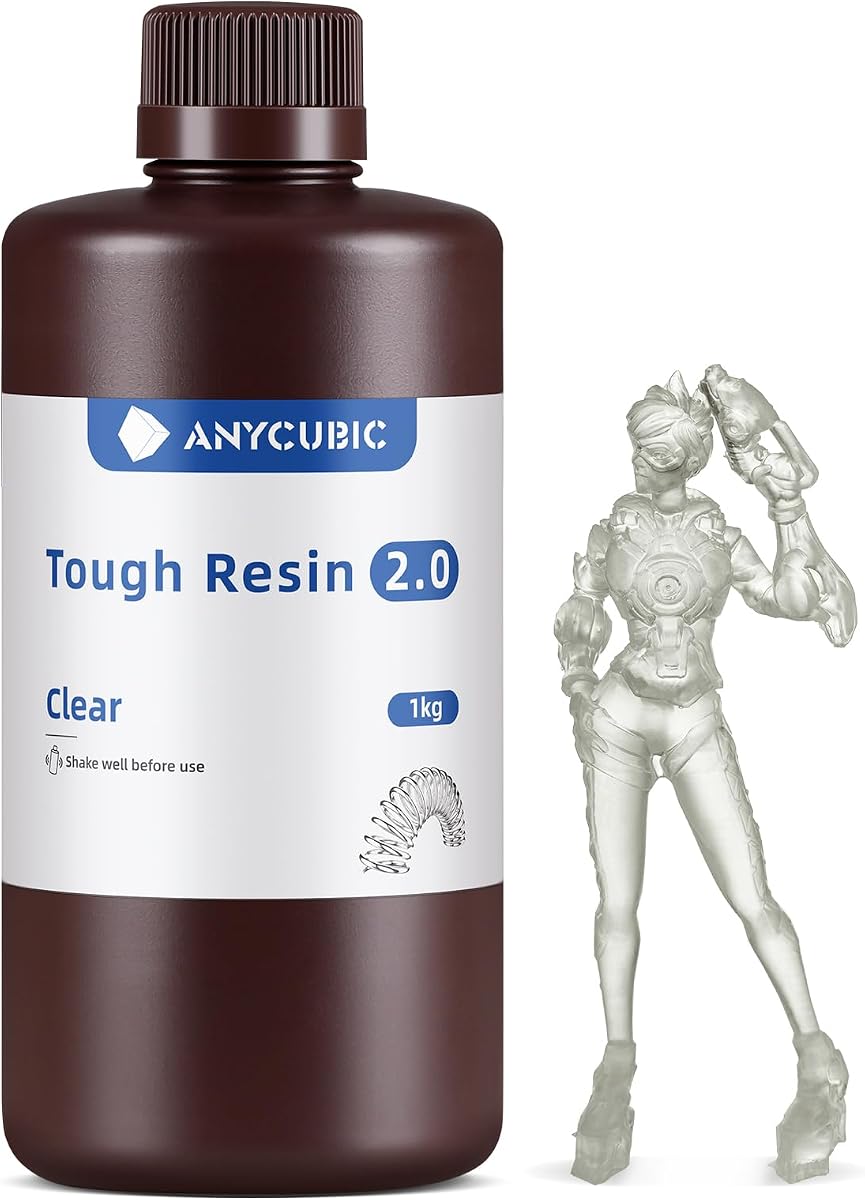
ANYCUBIC Tough 3D Printer Resin 2.0 Clear offers unmatched strength and high precision. It has achieved a significant enhancement in flexural strength reducing the likelihood of breakage. It offers exceptional strength and flexibility resisting damage caused by cyclic vibrations.
We may earn a commission when you buy through this link, at no additional cost to you.
The minimal odor and gentle composition pave the way for a serene printing environment. It ensures high precision prints with minimal shrinkage. Highly compatible with different equipment, it is designed for various industrial applications. It is a versatile choice for clear flexible parts.
While clear resin may show imperfections, it allows for detailed inspection of the part. The trade-off is manageable for the benefit of transparency and strength. It is excellent for parts where visual clarity and durability are required.
We recommend this for applications needing transparent durable parts. It is less likely to break even when dropped from a height. If you value industry compatibility and low odor, this is a strong option.
Significant enhancement in flexural strength significantly reducing the likelihood of breakage.
Ensures high precision prints with minimal shrinkage for accurate clear parts.
We may earn a commission when you buy through this link, at no additional cost to you.
This resin simulates the toughness of rubber with 90A Shore hardness. It can be folded and bent repeatedly without breaking with strong tear resistance. It is very suitable for cushioning and shock absorption. It works great on most LCD and DLP printers.
We may earn a commission when you buy through this link, at no additional cost to you.
It delivers high elongation and excellent tear resistance. It is the go-to choice for gaskets and protective cases. This specialized formula keeps its cool under stress. It delivers crisp accurate prints with a low-odor formula. It is built for makers and engineers.
With 90A hardness, it might be slightly stiffer than softer alternatives. The black color limits design versatility. However, for rugged applications requiring toughness, it is excellent. It handles end-use parts and frequent stress reliably.
We suggest this for engineering prototypes and frequently handled parts. It is ready to flex and last. If you need a reliable rubber-like resin, this is a strong candidate.
Flexible like rubber with tough enough to last properties. It can be folded repeatedly without breaking.
Say goodbye to cracked prints. It bends where ordinary resins snap.
We may earn a commission when you buy through this link, at no additional cost to you.
Choosing the right flexible resin requires evaluating hardness, elongation, odor, and printer compatibility to ensure your functional prototypes meet performance expectations.
Shore hardness determines how soft or hard the cured print feels. Lower values like 55A or 70A offer more rubber-like flexibility, while higher values like 80A or 90A provide more structural stiffness. Select a rating based on whether you need a gasket or a rigid flexible part.
Always check the Shore A rating to match your application needs.
Elongation at break indicates how much a material can stretch before tearing. High elongation percentages ensure the print can withstand stretching without cracking. Look for values above 100% for flexible items that undergo tension.
Higher elongation ensures the print remains intact under stress.
Impact resistance measures how well the print absorbs shock without breaking. For tools or durable prototypes, choose resins that explicitly state high impact resistance. This ensures the object survives drops or collisions during use.
Look for descriptions mentioning impact resistance or resilience for durability.
Some flexible resins emit strong odors during printing. Select options labeled low-odor or non-irritating for better comfort. Additionally, check for certifications like ISO 10993-5 if the item touches skin.
Choose low-odor and certified options for safety and comfort.
Flexible resins must match your printer wavelength typically 365nm or 405nm. Ensure the resin is compatible with LCD, DLP, or SLA printers. Using the wrong wavelength can lead to under-curing or failure.
Confirm 365-405nm compatibility before purchasing.
High shrinkage rates can distort printed parts. Look for resins that advertise low shrinkage for precise dimensions. This is critical for parts that must fit into specific assemblies or molds.
Prioritize low shrinkage for accurate part dimensions.
Resin handling involves pouring and mixing. Leak-proof bottles or strict packaging reduce waste and mess. This is especially important for liquid materials that can be messy during transfer.
Select brands with leak-proof packaging for safer handling.
Some flexible resins can be mixed with other resins to enhance toughness. If you want to modify standard resin, check if the product works well as an additive. This offers customization for unique material properties.
Check for additive compatibility if you plan to mix resins.
Shake the resin bottle gently for a few minutes before printing to ensure all components are well mixed. Avoid vigorous shaking that introduces air bubbles into the vat.
Use standard isopropyl alcohol to clean prints thoroughly. Flexible prints are sticky, so take extra time to ensure all uncured resin is removed from the surface.
Post-cure the prints under a UV curing station for the recommended time. Ensure proper ventilation during curing to maintain a safe workspace.
For soft gaskets, aim for Shore hardness between 55A and 70A. This range provides the necessary flexibility to compress and seal effectively without deforming permanently over time.
Yes, provided the resin is certified safe for skin contact. Look for ISO 10993-5 testing and non-irritating formulations to ensure comfort and safety for items like earpiece covers or cosplay parts.
Air bubbles often occur during shaking. Let the resin sit in the vat for a few minutes before printing to allow bubbles to rise. Using a vacuum chamber before printing can also minimize bubbles.
Isopropyl alcohol (IPA) is the standard solution for cleaning flexible resin prints. It dissolves uncured material effectively. Ensure you use high-purity IPA to avoid residue on your flexible parts.
Curing times vary by brand but typically range from 30 to 60 minutes under a UV lamp. Follow the manufacturer's specific recommendations to ensure the part reaches its full strength and flexibility.
Yes, some flexible resins are designed to be used as additives to boost toughness in standard resins. Always test a small batch first to ensure the mixed properties meet your requirements.
Flexible prints can remain sticky if not fully cured or cleaned. Ensure thorough washing with alcohol and sufficient UV exposure. Sticky surfaces usually indicate residual uncured material on the surface.
Yes, flexible resins generally cost more due to specialized formulations. However, the functional benefits often justify the cost for prototyping and engineering applications where durability is critical.
The ANYCUBIC Ultra Tough Resin, Siraya Tech Tenacious Highly Flexible, and Siraya Tech Rebound 55A lead the market for their performance and versatility. These top picks offer excellent elasticity, durability, and ease of use for various projects.
When selecting a resin, prioritize your specific needs such as hardness, odor, or print speed. Functional prototypes need impact resistance while wearables require skin safety certification.
Prices for these materials change frequently so verify current offers before purchasing. Always follow manufacturer guidelines for cleaning and curing to get the most out of your flexible resin prints.