
FNIRSI DSO152
4.4Editor score
200kHz Bandwidth
2.5MS/s Sampling
Portable Pocket Design
Finding a reliable oscilloscope does not have to break the bank. Whether you are a student, hobbyist, or professional technician, there are affordable options that deliver impressive performance without the premium price tag. These devices allow you to visualize electrical signals, troubleshoot circuits, and validate designs effectively.
To compile this list, we evaluated ten top-rated models based on bandwidth, sampling rate, display quality, and additional features like multimeters or signal generators. We focused on units that offer the best balance between cost and capability, ensuring they meet the needs of various users from beginners to advanced engineers.
Each pick in this guide highlights specific strengths and ideal use cases. We include detailed specs and pros and cons to help you make an informed decision. Please note that prices and availability change frequently, so check the current listings before purchasing to ensure you get the best deal available today.
4.4Editor score

4.3Editor score

4.1Editor score
As an Amazon Associate we earn from qualifying purchases.
This comparison table provides a side-by-side overview of all ten models featured in this guide. It highlights key specifications such as bandwidth, sampling rate, display size, and unique features to help you quickly identify the device that best fits your specific testing requirements and budget constraints.



The FNIRSI DSO152 stands out as one of the most accessible entry-level oscilloscopes available today. With a solid rating of 4.4 stars, it is praised for its simplicity and low cost. This device is ideal for educational purposes or basic hobbyist projects where high-end features are not necessary.
We may earn a commission when you buy through this link, at no additional cost to you.
Its 200kHz bandwidth and 2.5MS/s sampling rate are sufficient for analyzing audio signals, basic logic gates, and slow digital communications. The 2.8-inch HD LCD display offers clear visualization of waveforms, and the one-key AUTO function simplifies setup significantly. The included 10x probe allows for safe measurement up to 400 volts.
However, users should be aware of its limitations. The battery life is around 4 hours, which might be short for long field sessions. The resolution of 320 by 240 pixels is functional but lacks the crispness of larger displays. It is best suited for those who need a basic tool rather than a professional grade instrument.
If you are looking for the cheapest way to get started with signal analysis, this model is an excellent choice. It provides the fundamental functionality needed to learn oscilloscope basics without a heavy financial investment. We recommend it for students and hobbyists who do not need advanced features like spectrum analysis or multi-channel comparison.
The one-key AUTO button makes it incredibly easy for beginners to capture waveforms without complex manual adjustments.
Its pocket-sized design and lightweight build make it perfect for carrying around workshops or field sites.
We may earn a commission when you buy through this link, at no additional cost to you.
The FNIRSI 2C53T is a versatile device that combines an oscilloscope, multimeter, and signal generator into a single unit. Rated at 4.3 stars, it appeals to technicians who need a comprehensive toolkit without carrying multiple instruments. The FPGA+MCU+ADC hardware architecture ensures stable and precise signal capture.
We may earn a commission when you buy through this link, at no additional cost to you.
With 50MHz bandwidth and 250MSa/s sampling, it handles a wider range of signals than basic hobbyist models. The 4.5-digit multimeter adds significant value, allowing for accurate voltage and resistance measurements. The signal generator supports up to 13 waveform types, which is useful for testing circuits without external equipment.
While the features are impressive, the interface can be slightly complex for first-time users. The battery life is strong at 6 hours, but the screen brightness might need adjustment for outdoor use. It is a robust tool for automotive diagnostics and general electronics repair where versatility is key.
We recommend this model for professionals and serious hobbyists who want maximum functionality in a portable package. It bridges the gap between cheap pocket scopes and expensive benchtop units. If you need to measure, generate, and analyze signals on the go, this is a top contender.
Integrating three distinct tools into one chassis saves space and reduces the cost of buying separate devices.
Advanced features like XY mode and math operations allow for deeper insight into circuit behavior.
We may earn a commission when you buy through this link, at no additional cost to you.
The FNIRSI DPOS350P offers a level of performance rarely seen in this price range. With a 350MHz bandwidth and 1GSa/s sampling rate, it can handle fast digital signals and RF applications effectively. Its 4.1 rating reflects its powerful capabilities despite being more advanced than standard options.
We may earn a commission when you buy through this link, at no additional cost to you.
It includes spectrum analysis and frequency response analyzer features, which are typically found on much more expensive benchtop units. The 7-inch touchscreen makes navigation intuitive and improves waveform visualization. The 8000mAh battery ensures it can run for extended periods without needing a wall outlet.
The trade-off is increased weight and cost compared to the other units on this list. The larger dimensions make it less pocket-friendly, though still portable enough for field work. It is designed for users who need professional-grade tools without the professional price tag.
This model is best for engineers or technicians working on complex electronics like power supplies or embedded systems. If you need accurate FFT analysis and high-speed signal capture, this device provides excellent value. It is our premium pick for those who demand high performance.
Includes spectrum analyzer and frequency response analysis to handle complex signal integrity tasks.
The large 7-inch touchscreen offers detailed views and easy control of complex parameters.
We may earn a commission when you buy through this link, at no additional cost to you.
The FNIRSI DSO-510 is designed for users who need basic signal visualization and generation. With a 10MHz bandwidth, it is perfect for audio and low-frequency digital logic. The 4.4 rating indicates high user satisfaction for its specific use case and ease of use.
We may earn a commission when you buy through this link, at no additional cost to you.
It features a DDS signal generator capable of outputting up to 13 waveform types. This allows you to inject test signals into circuits directly. The infinite afterglow feature helps in capturing and viewing transient signals that might be hard to see otherwise.
Due to its lower bandwidth, it is not suitable for high-speed data lines or RF work. The battery lasts about 4 hours, which is standard for this class of device. It is a reliable companion for simple repairs or educational labs.
We recommend this for hobbyists focusing on audio electronics or microcontroller debugging. It provides the essential tools needed for basic testing without unnecessary complexity. If you just need to see if a signal is present and stable, this is a solid choice.
The built-in DDS generator allows you to test circuit responses without additional hardware.
Infinite afterglow helps visualize intermittent or rare signal events clearly.
We may earn a commission when you buy through this link, at no additional cost to you.
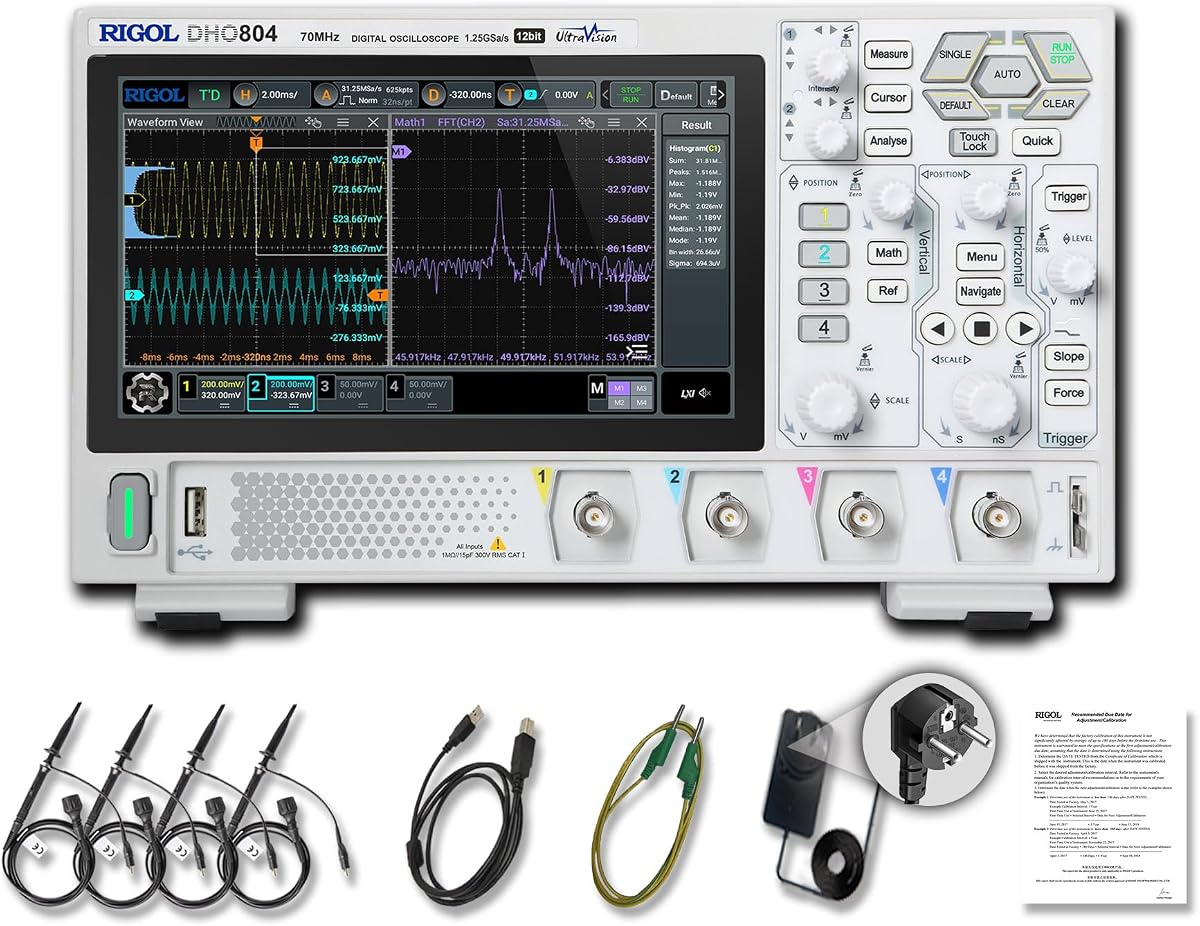
RIGOL is a well-respected name in test equipment, and the DHO804 proves why. It offers 12-bit resolution which is rare for portable units, allowing for fine vertical detail. The 4.3 rating shows it is trusted by professionals for demanding tasks.
We may earn a commission when you buy through this link, at no additional cost to you.
With four channels and a high sampling rate, it can capture complex systems with multiple signals simultaneously. The UltraAcquire technology helps in finding intermittent glitches quickly. This makes it ideal for power supply ripple analysis and embedded system debugging.
The main drawback is the cost, which is higher than most of the other options listed here. It is also heavier due to the larger display and robust build. However, for those who need precision, the extra cost is often justified by the quality of data.
This is our recommendation for users who require professional-grade resolution in a portable form. It is suitable for university labs or field engineers who need reliable measurements. If clarity of small signal details matters to your work, this model is worth the investment.
12-bit resolution provides better vertical detail than standard 8-bit scopes for small signals.
Four channels allow you to monitor multiple parts of a circuit simultaneously without swapping probes.
We may earn a commission when you buy through this link, at no additional cost to you.
The FNIRSI 2C53P brings a touchscreen experience to the budget segment. With a 4.3-inch IPS display, it offers a modern interface that many users prefer over physical buttons. However, the lower rating of 3.8 suggests some reliability or usability issues may arise.
We may earn a commission when you buy through this link, at no additional cost to you.
It shares many specs with the 2C53T but focuses on the touch experience. The 50MHz bandwidth is capable for general electronics. The battery life is extended to about 4 hours of continuous use, which is convenient for fieldwork.
Some users report that the touch response might not be as precise as physical buttons in certain conditions. It is still a capable tool for its price. If you prioritize interface modernity over pure utility, it is an interesting option.
We recommend this for users who find traditional button menus difficult. It is a good step up from basic handheld scopes. Just be prepared to adapt to the touchscreen controls if you are used to traditional instruments.
The capacitive touchscreen offers a more intuitive way to control settings and view data.
The 4.3-inch screen provides more space to view waveforms and menus clearly.
We may earn a commission when you buy through this link, at no additional cost to you.
The FNIRSI 1013D Plus delivers a desktop-like experience in a portable form. It features a 7-inch touchscreen with high resolution, making it easy to read waveforms. With a 4.4 rating, it is well-regarded for its display quality and ease of use.
We may earn a commission when you buy through this link, at no additional cost to you.
Its 100MHz bandwidth makes it suitable for a wide range of applications, including embedded systems and motor control. The 1GB storage space allows you to save many screenshots and waveform sets. This is great for documentation and sharing results.
The main downside is its bulk, as it is heavier than pocket models. The 6000mAh battery is strong but may drain faster at high brightness settings. It is a great choice for bench work where portability is secondary to viewing size.
We suggest this for users who spend most of their time on a bench. The large screen reduces eye strain during long testing sessions. If you want the most comfortable viewing experience in this category, this is the model to consider.
Extensive storage space lets you save many screenshots for reports or project records.
High resolution TFT display ensures clear and detailed waveform visibility.
We may earn a commission when you buy through this link, at no additional cost to you.
The FNIRSI 2C23T is a reliable model with a high user rating of 4.6. It combines an oscilloscope with a multimeter, which is great for basic diagnostics. Its 10MHz bandwidth limits it to low frequency tasks, but it is very effective for that range.
We may earn a commission when you buy through this link, at no additional cost to you.
It features a straightforward interface that is easy for beginners to learn. The multimeter function is quite comprehensive, covering voltage, current, and resistance. This makes it a practical all-in-one tool for general repairs.
The design is a bit dated compared to newer models with touchscreens, but it is functional. The battery life is solid for basic tasks. It is an excellent choice for those who prioritize utility over flashy features.
We recommend this for students and hobbyists looking for a first oscilloscope. It teaches the basics without overwhelming complexity. If you need a tool to check basic circuits and measure DC voltage, this is a strong candidate.
The 4-digit multimeter offers precise readings for common electrical parameters.
Minimal buttons and straightforward menus make it very easy to use.
We may earn a commission when you buy through this link, at no additional cost to you.
The FNIRSI 2D15P is a strong mid-range option with 100MHz bandwidth and 500MS/s sampling. It combines all three tools in one, which is highly efficient for repair work. The 4.1 rating indicates it performs well for general testing needs.
We may earn a commission when you buy through this link, at no additional cost to you.
It supports curve view and FFT analysis, which are useful for detailed signal work. The 4.3-inch touchscreen provides a modern interface. The 5000mAh battery ensures extended use without interruption in the field.
However, the menu system can be complex compared to simpler models. The cost is higher than the entry-level options, which might be a barrier for some. It is best for those who need the extra bandwidth and features.
We suggest this for technicians who need a balance of performance and portability. It handles more complex signals than the 10MHz units. If you need to work on automotive or power electronics, this unit provides the necessary performance.
FFT and curve view features allow for detailed analysis of complex signals.
A 5000mAh battery supports long hours of fieldwork without recharging.
We may earn a commission when you buy through this link, at no additional cost to you.
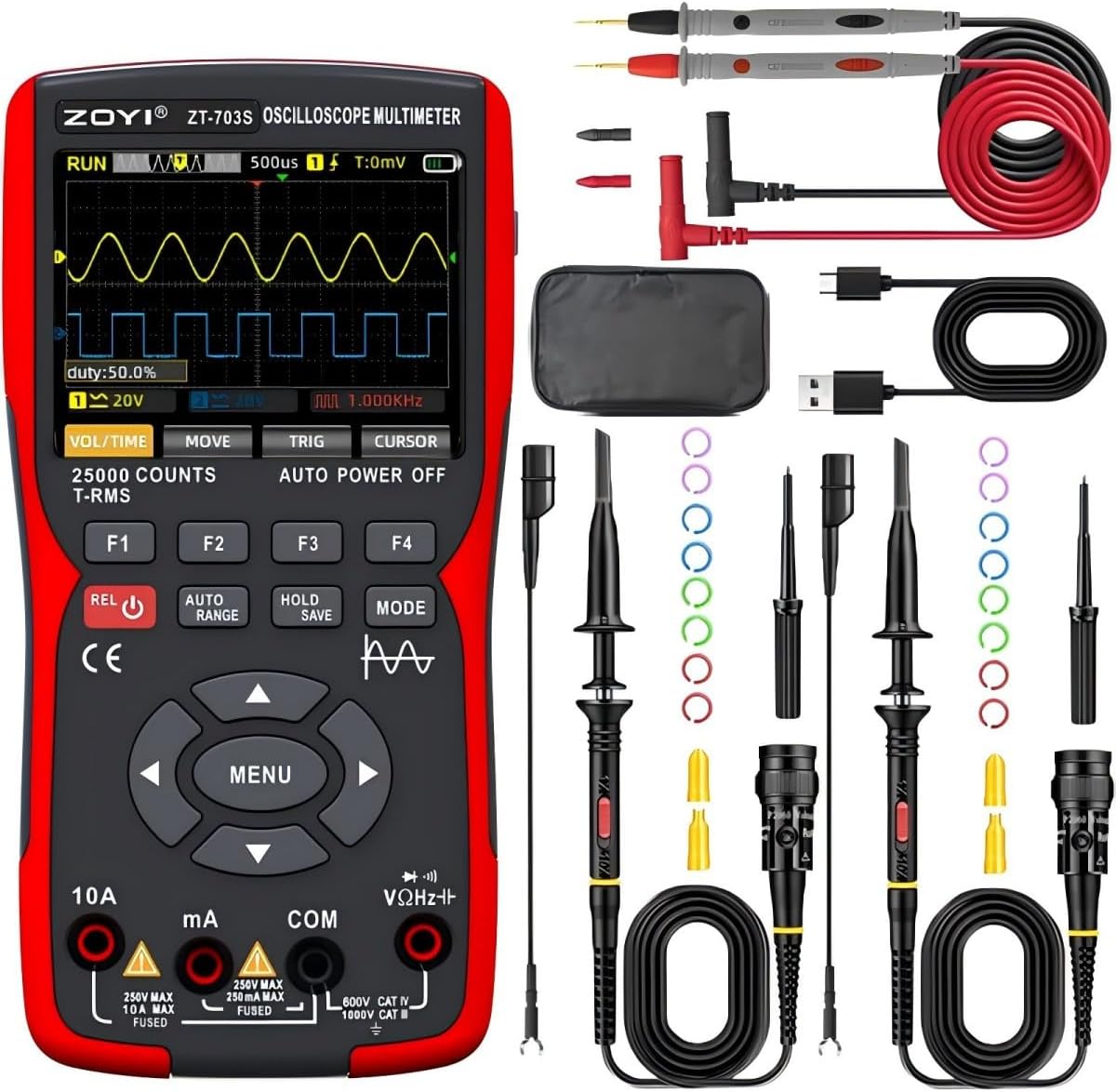
This generic model offers a high rating of 4.6 with solid specs including 50MHz bandwidth and 280MSa/s sampling. It is a cost-effective alternative to branded models while delivering similar core functionality. The auto mode feature helps in handling unknown waveforms efficiently.
We may earn a commission when you buy through this link, at no additional cost to you.
It includes a multimeter with 25000 counts, which is precise for many electrical tests. The Type-C charging port is a modern convenience that many older scopes lack. It is a versatile tool for general electronics and automotive work.
One downside is that the manual may vary as packaging changes, so you might need to search for guidance. The interface might not be as polished as branded units. Still, the performance is robust for the price.
We recommend this for budget-conscious buyers who need high performance. It is a practical tool for those who want a mix of features without paying for a brand name. If value is your main concern, this is a great choice.
Type-C interface supports fast charging for quick turnaround between field sessions.
Auto recognition helps quickly visualize unknown waveforms without manual setup.
We may earn a commission when you buy through this link, at no additional cost to you.
Selecting the right oscilloscope involves balancing technical needs with your budget. This section details the key factors you should evaluate to ensure you choose a device that serves your specific tasks effectively.
Bandwidth determines the maximum frequency the scope can accurately measure. For digital and high-speed signals, choose at least three to five times the highest frequency of your signal. For audio or slow logic, 10MHz to 50MHz is sufficient.
Always match the bandwidth to your highest expected signal frequency to avoid distortion and measurement errors.
Sampling rate dictates how many samples per second the device captures. A higher rate allows you to see finer details in the waveform. Look for rates that are at least four to five times the bandwidth for reliable reconstruction.
Higher sampling rates are crucial for capturing transient spikes and detailed edges in digital signals.
Channel count refers to the number of input signals you can view simultaneously. Two channels are standard for most basic work, but four channels are needed for complex multi-rail power systems or differential signals.
Choose more channels if you need to compare signals from different parts of a circuit at the same time.
Memory depth is the number of samples stored for each acquisition. Deep memory allows for long duration captures at high sample rates. This is essential for capturing rare events or long serial data streams.
Ensure the memory depth is adequate to capture the longest duration you need at your required sample rate.
A clear display with high resolution makes waveform analysis easier. Touchscreens can speed up setup, but physical buttons are often more reliable in dusty environments. Ensure the screen is large enough to see your waveforms clearly.
Prioritize a display type that matches your environment and your comfort with digital or physical controls.
Many affordable scopes include multimeters or signal generators. These add value and reduce the need for multiple devices. Features like spectrum analysis or USB connectivity can also enhance your workflow.
Consider which extra tools you actually need to avoid paying for features you will not use.
Battery life and weight are critical for field work. Look for scopes with Type-C charging and long battery life. A lighter unit is easier to carry around for repairs and diagnostics.
Choose a model with enough battery capacity to last through your typical work session without needing a recharge.
Connectivity options like USB or Ethernet allow for data export and remote control. This is useful for saving screenshots or integrating with lab PCs. Check if the device supports drivers or web browsers for control.
Ensure the device has the necessary ports to save your data or connect to your computer if needed.
Always start by calibrating the probe and ensuring it is set to the correct attenuation ratio. Use the auto-setup feature to get a stable waveform quickly, then adjust the voltage and time divisions manually to zoom in on the details.
To capture intermittent glitches, use the infinite persistence mode or set the trigger to hold off conditions that capture rare events. This allows you to see spikes that might disappear too quickly for the eye to catch on a single shot.
For maintenance, store the device in a dry and cool place to protect the battery and screen. Avoid dropping the unit or exposing it to high humidity. Use the built-in battery management system to prevent deep discharge when not in use.
For most hobbyist electronics and microcontroller projects, a 10MHz bandwidth is generally sufficient. It allows you to see clean square waves and audio signals without distortion. If you plan to work on faster digital logic or RF, you may need at least 50MHz.
Yes, modern handheld units like the ones listed here can be quite accurate for field diagnostics. They are suitable for checking signal presence, timing, and amplitude. However, for precise metrology or calibration work, a benchtop model with higher standards is recommended.
Absolutely. Many of these models support voltages up to 400V and include automotive-specific features. They are excellent for checking sensor signals, ignition pulses, and data bus activity in vehicles. Just ensure you use the correct probes for safety.
Connect the probe to the calibration output on the scope. Adjust the small screw on the probe until the square wave on the screen has flat tops and clean corners. This ensures the probe is correctly compensated for the circuit you are measuring.
Digital scopes use sampling and storage to capture waveforms, allowing for math functions and storage. Analog scopes show signals directly on a CRT or LCD without sampling. Digital units are more versatile and are the standard for modern electronics repair.
Most models in this list include a built-in lithium battery. This allows you to use them without a constant power source. Battery life varies by model and screen brightness, but typically ranges from four to six hours of continuous use.
We have reviewed ten excellent models that balance performance and price. The FNIRSI DSO152 offers the best entry point for beginners, while the FNIRSI DPOS350P delivers professional features at an affordable price. The RIGOL DHO804 stands out for those needing high-resolution measurements.
Prioritize bandwidth and sampling rate based on your specific applications. If you need versatility, a three-in-one model like the FNIRSI 2C53T provides great value. If you prefer a large display, the FNIRSI 1013D Plus is a comfortable choice for bench work.
Remember to check current prices and availability before buying as these can change frequently. We hope this guide helps you find a reliable tool that fits your needs and budget. Investing in the right oscilloscope will significantly improve your electronics troubleshooting efficiency.