
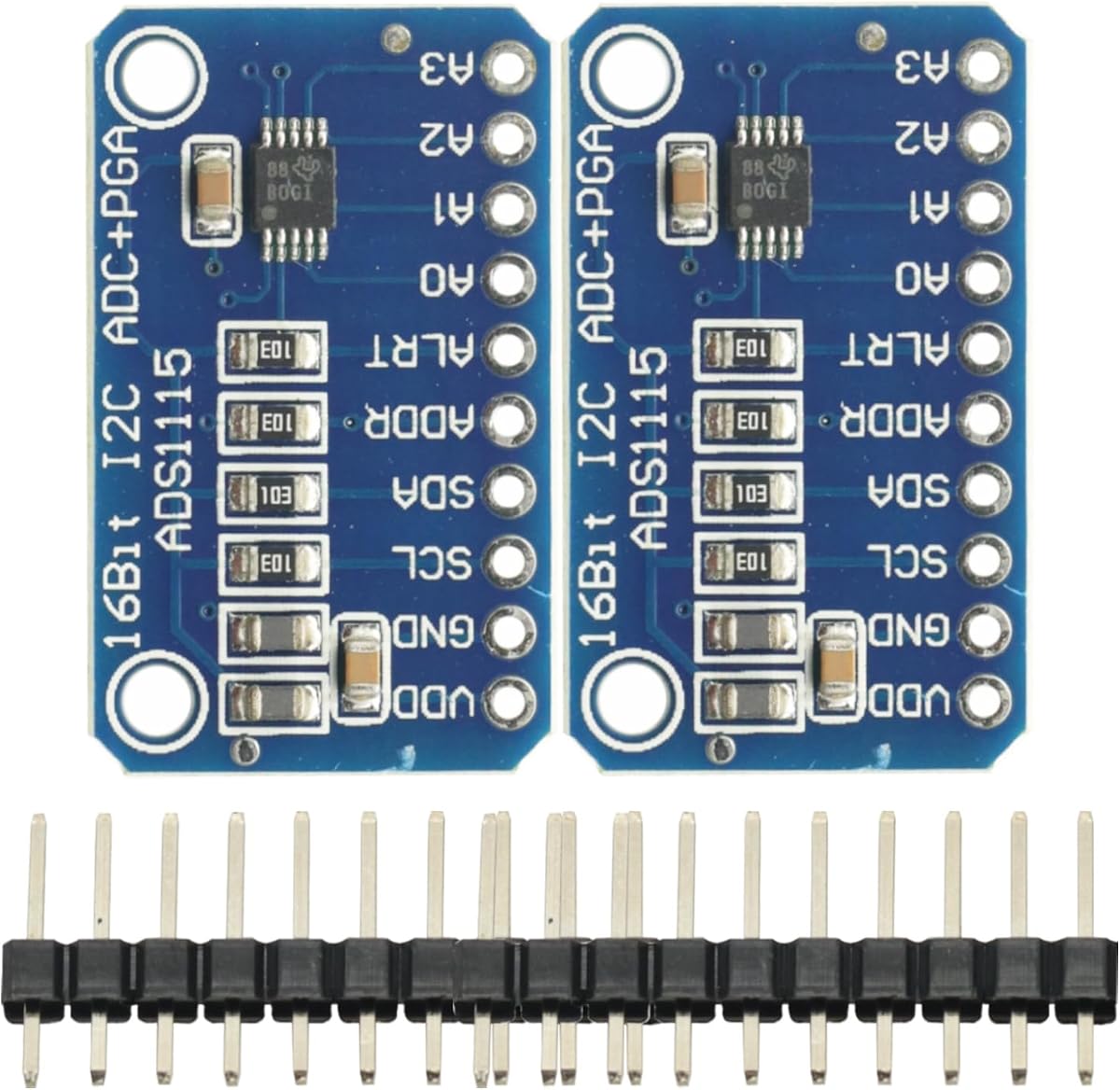
2Pcs ADS1115 16 Bit I2C Module Precision ADC 4 Channel Analog-to-Digital Converter Development Board Pro Gain Amplifier for Arduino Raspberry Pi ADC Module
5.0Editor score
Compact module design
Multiple input ranges
Easy I2C integration
This guide compares the top Arduino ADC Board options for 2026, evaluating precision, channel count, and integration ease for reliable analog data acquisition.
Choosing the right Arduino ADC Board is essential for projects requiring precise analog measurements. Without native analog capabilities on some microcontrollers, external converters bridge the gap between sensors and digital logic. A good board offers high resolution, stable voltage references, and reliable communication protocols for accurate data logging.
We evaluated ten leading ADC modules based on resolution, channel count, interface types, and overall build quality. Our analysis considered compatibility with popular platforms like Arduino and Raspberry Pi. Each selection balances performance with ease of use, ensuring they meet the demands of hobbyists and professionals alike.
Every pick in this list highlights specific strengths such as programmable gain or multi-channel support. These details help you match the hardware to your unique project needs. Note that product availability and pricing fluctuate regularly, so verify current details before finalizing your purchase decisions.
5.0Editor score

4.7Editor score

4.4Editor score
The following table provides a side-by-side overview of all ten selected ADC modules. It outlines key specifications including channel configurations, communication interfaces, and resolution capabilities to help you quickly identify the right fit for your application.




This Teyleten Robot ADS1115 module stands out as a top choice for precision analog conversion. With a 4.7 rating from users, it delivers reliable performance for projects needing detailed voltage measurements. Its programmable gain amplifier allows for flexible signal conditioning across various input ranges.
We may earn a commission when you buy through this link, at no additional cost to you.
The module features a wide supply range from 2.0V to 5.5V, making it compatible with both 3.3V and 5V logic systems. Users appreciate the ability to configure data rates from 8sps to 860sps, balancing speed and resolution. The built-in PGA helps amplify small signals from sensors like thermocouples or strain gauges effectively.
While it offers excellent accuracy, the single-ended input configuration can limit differential measurements compared to specialized boards. The I2C interface is standard but requires careful address configuration when chaining multiple devices. These trade-offs are acceptable for most general-purpose data acquisition tasks where cost and simplicity matter.
Builders working on environmental monitoring or low-voltage sensor projects will find this board highly suitable. Its ease of integration with Arduino and Raspberry Pi platforms ensures quick deployment. We recommend this module for those prioritizing resolution and flexibility without exceeding budget constraints.
The onboard PGA allows users to adjust input ranges dynamically, enhancing sensitivity for low-voltage signals without external components.
Supporting voltages from 2.0V to 5.5V ensures compatibility with diverse microcontroller logic levels, simplifying power supply design.
We may earn a commission when you buy through this link, at no additional cost to you.
The HiLetgo ADS1256 offers exceptional resolution with its 24-bit ADC chip, ideal for applications requiring minute voltage detection. Rated at 4.6, it is favored for industrial-grade data acquisition where precision is non-negotiable. The chip includes a dedicated reference voltage source for stable measurements.
We may earn a commission when you buy through this link, at no additional cost to you.
Featuring eight channels, this module supports multiple sensor inputs simultaneously. The nonlinearity is kept low at ±0.0010%, ensuring accurate readings across the full range. Users can configure it for either 8 single-ended or 4 differential inputs, providing flexibility for different sensor types.
However, the complexity of wiring and higher power demands might be challenging for simple hobby projects. The SPI protocol requires more pins than I2C, which can complicate breadboard setups. Despite this, the performance justifies the effort for critical measurement tasks.
Engineers and serious hobbyists needing high-fidelity data collection will benefit most from this board. Its stability and channel count make it suitable for multi-sensor arrays. Consider this option if resolution and accuracy are your primary project drivers.
The 24-bit resolution allows for detecting microvolt-level changes, making it perfect for strain gauges and load cells.
Configurable as single-ended or differential inputs provides versatility in connecting various analog sensors and measurement setups.
We may earn a commission when you buy through this link, at no additional cost to you.
This ADS1115 module package has achieved a perfect 5.0 rating, reflecting strong user satisfaction with its performance. It provides a cost-effective solution for those needing 16-bit precision without breaking the bank. The included gain amplifier enhances its utility for low-signal applications.
We may earn a commission when you buy through this link, at no additional cost to you.
Users value the straightforward I2C integration, which simplifies wiring on crowded breadboards. The programmable data rate allows tuning speed versus accuracy based on project needs. Supporting input ranges from ±0.256V to ±6.144V offers flexibility for various sensor outputs.
The module is compact and fits well in tight enclosures, though standard 16-bit resolution may not suffice for ultra-high precision needs. Some users note the need for external pull-up resistors on I2C lines if not included, which adds slight setup complexity.
For students, hobbyists, or prototyping phases, this board offers excellent value. It balances performance and price effectively, making it accessible for large-scale deployments. We recommend it for general-purpose projects where high-end precision is not critical.
The 5.0 rating indicates consistent quality and reliability, with users praising its accuracy and ease of integration in projects.
Adjusting data rates from 8sps to 860sps allows balancing power consumption and speed depending on specific application requirements.
We may earn a commission when you buy through this link, at no additional cost to you.
This HiLetgo pack provides three ADS1115 modules, offering great value for projects requiring multiple conversion points. With a 4.3 rating, it is appreciated for its reliable performance across various environments. The comparator mode allows setting thresholds for alerts without constant polling.
We may earn a commission when you buy through this link, at no additional cost to you.
The wide voltage supply range ensures compatibility with both 3.3V and 5V systems. Users find it particularly useful for Raspberry Pi projects that lack native analog pins. The programmable gain amplifier supports a range of input signals for versatile sensor interfacing.
While the multiple boards are advantageous for larger setups, standard I2C wiring requires attention to address management. The comparator feature is helpful but requires code implementation to trigger alerts effectively. These aspects are manageable with proper documentation.
This option suits teams or educators needing spares for classrooms or group projects. Its balanced feature set makes it a practical choice for general data acquisition. We suggest it for those planning multi-node monitoring systems.
Comparator mode enables users to set voltage thresholds for triggering interrupts, useful for alarm systems without constant CPU polling.
Operating from 2.0V to 5.5V ensures adaptability across different microcontroller platforms, simplifying power supply design for projects.
We may earn a commission when you buy through this link, at no additional cost to you.
Offering four ADS1115 modules in a single package, this set provides ample capacity for distributed sensor projects. Rated at 4.1, it delivers consistent performance for standard analog-to-digital conversion tasks. The internal oscillator ensures stable timing without external components.
We may earn a commission when you buy through this link, at no additional cost to you.
Users highlight the high accuracy and programmable gain amplifier, which support diverse input requirements. The wide voltage supply range further enhances compatibility with different microcontroller systems. It is a practical choice for projects requiring several independent measurement points.
However, configuring I2C addresses when multiple units are active requires careful pin setting. The basic PCB design may not be suitable for industrial-grade environmental conditions. These limitations are minor for prototyping or hobby applications.
Educators and project managers managing multiple stations will find this quantity advantageous. It reduces the need for individual purchases, saving time and effort. Consider this set for distributed monitoring networks or large-scale testing.
The internal oscillator provides stable timing signals, removing the need for external clock components and simplifying board design.
Supporting voltages from 2.0V to 5.5V ensures adaptability across diverse microcontroller systems, simplifying power design.
We may earn a commission when you buy through this link, at no additional cost to you.
This dual-module kit has earned a 5.0 rating, indicating exceptional reliability and user satisfaction. It provides two precise converters for parallel projects or backup units. The programmable data rate allows users to optimize performance for their specific needs effectively.
We may earn a commission when you buy through this link, at no additional cost to you.
Users appreciate the flexibility of multiple input ranges, enabling accurate readings across different signal levels. The compact size fits easily into small enclosures, ideal for embedded applications. Setup is straightforward with standard I2C connections on most microcontrollers.
While the modules are robust, they are limited to single-ended inputs in standard configurations, which may reduce noise immunity. External voltage references may be needed for ultra-stable measurements in sensitive environments. These issues are manageable for most hobby-level uses.
This kit is excellent for pairs needing redundancy or quick prototyping. Its high satisfaction score reflects consistent build quality and performance. We recommend it for those prioritizing reliability and simplicity in their design.
Adjustable input ranges allow precise measurements across diverse signal voltages, enhancing the module's versatility in various projects.
The small footprint fits easily in tight enclosures, making it ideal for space-constrained embedded systems or portable devices.
We may earn a commission when you buy through this link, at no additional cost to you.
The Lonely Binary ADS1115 modules distinguish themselves with premium ENIG gold plating for superior solderability. Rated at 4.4, they offer robust reliability for long-term deployments. The lead-free construction aligns with environmental standards while maintaining high performance.
We may earn a commission when you buy through this link, at no additional cost to you.
Users highlight the ability to chain up to four modules on one bus, enabling up to 16 channels. Logic tolerance for 3.3V and 5V systems ensures compatibility with ESP32 and Arduino alike. Library support for C++ and Python simplifies development across platforms.
The premium build quality comes at a higher cost, which may not suit every budget. Some users find the brand-specific focus limits broader availability. However, for critical applications, the durability and support justify the investment.
This set is ideal for professional projects or educational labs requiring consistent quality. Its chaining capability reduces wiring complexity significantly. We recommend it for those prioritizing hardware durability and expandability.
Gold plating enhances corrosion resistance and ensures reliable solder connections, critical for long-term or outdoor deployments.
Addressable I2C modules allow chaining multiple units on one bus, expanding channel count without additional controller pins.
We may earn a commission when you buy through this link, at no additional cost to you.
This AD7606 module is designed for high-speed industrial applications requiring rapid data capture. While rated 3.0 due to setup complexity, it offers exceptional sampling rates of 200KHz. The eight channels operate synchronously, ensuring simultaneous measurements across all inputs.
We may earn a commission when you buy through this link, at no additional cost to you.
Featuring SPI protocol, it delivers data quickly to microcontrollers. The wide input voltage range of ±5V or ±10V supports diverse industrial signal types. An internal 2.5V reference maintains stability during continuous operation cycles.
The complexity of SPI wiring and high power needs limit its appeal for casual hobby projects. Users must ensure their controller supports high-speed SPI communication effectively. These trade-offs are acceptable for specialized high-frequency data logging tasks.
This board suits engineers working on power monitoring or vibration analysis where timing is critical. The synchronous sampling ensures phase-accurate data across channels. Consider this option for demanding industrial scenarios requiring speed.
All eight channels sample data simultaneously, crucial for analyzing phase relationships between signals in multi-channel systems.
200KHz sampling rate allows capturing fast-changing signals, making it ideal for dynamic industrial monitoring tasks.
We may earn a commission when you buy through this link, at no additional cost to you.
This four-pack ADS1115 kit delivers a 4.6 rating, reflecting its reliability and utility for data acquisition. Each module provides high-resolution 16-bit conversion suitable for sensors needing accuracy. The built-in programmable gain amplifier simplifies interfacing with low-voltage devices.
We may earn a commission when you buy through this link, at no additional cost to you.
Users appreciate the I2C interface, which simplifies wiring compared to other protocols. Compatibility with platforms like ESP32 and STM32 extends its use cases. The four units allow for simultaneous multi-node testing or redundancy in critical systems.
Basic packaging may leave components vulnerable during shipping, requiring careful handling. Address ranges are standard, necessitating manual pin changes for multiple units. These minor issues do not detract from the module's strong performance.
Ideal for teams or classrooms requiring consistent hardware across projects, this kit saves procurement time. Its performance justifies the investment for stable measurements. We recommend it for scalable IoT or sensor network projects.
The 16-bit resolution ensures stable and accurate data, essential for reliable sensor monitoring and precise experimental results.
Compatibility with platforms like ESP32 and STM32 ensures the module fits diverse development ecosystems and project requirements.
We may earn a commission when you buy through this link, at no additional cost to you.
This HiLetgo ADS1115 module is a classic choice for analog to digital conversion, rated 4.3. It offers straightforward integration via I2C, making it ideal for beginners or rapid prototyping. The programmable gain amplifier enhances its utility for small signal measurement tasks.
We may earn a commission when you buy through this link, at no additional cost to you.
Users value the wide voltage supply range and comparator mode, which enables alert systems without continuous polling. Its design supports Raspberry Pi projects lacking analog pins, broadening its utility in embedded systems. It remains a staple for reliable measurements.
While effective, it offers standard resolution that may not meet high-end accuracy needs. The basic design lacks advanced features found in newer models. These constraints are acceptable for general purpose applications where simplicity is key.
For hobbyists and small developers seeking a proven ADC module, this board remains a strong contender. Its compatibility and ease of use ensure quick setup. We suggest it for projects prioritizing simplicity and cost-effectiveness.
Comparator mode allows threshold setting for interrupts, enabling efficient alarm systems without continuous CPU polling or processing.
I2C connectivity simplifies wiring with just two lines, making it easy to integrate into existing microcontroller systems quickly.
We may earn a commission when you buy through this link, at no additional cost to you.
Selecting the right ADC board depends on your project requirements regarding precision, channels, and interface. This guide breaks down the critical factors to ensure you make an informed decision.
Resolution determines how finely the board can measure voltage changes. Higher bit counts like 16 or 24 bits provide better precision for sensors with small signals. Accuracy is also influenced by internal voltage reference stability and temperature drift.
Look for boards with high bit counts and stable references to ensure reliable readings over time.
Consider how many analog sensors you need to connect simultaneously. Some boards offer four channels while others support eight or more. Single-ended or differential configurations affect noise rejection capabilities and sensor compatibility.
Choose the number of channels that matches your sensor count and noise environment requirements.
Common interfaces include I2C, SPI, and UART. I2C uses fewer pins but may be slower, while SPI is faster but requires more wiring. Ensure the interface is supported by your microcontroller and fits your wiring constraints.
Select an interface that balances speed and wiring complexity for your specific development environment.
Check if the board supports your logic voltage, typically 3.3V or 5V. Some modules operate over a wide range, making them versatile across platforms. Ensure voltage levels match to prevent damage or signal errors.
Prioritize boards with wide voltage tolerance to simplify power supply design.
A PGA allows amplifying low-level signals before conversion, improving resolution for small sensors. It reduces the need for external amplifiers and simplifies circuit design. Check if the gain is software-configurable for flexibility.
Modules with built-in PGAs are better for low-voltage sensor applications.
Industrial-grade components and plating affect long-term reliability. Look for boards with robust PCB materials and lead-free compliance. These factors matter for outdoor or high-temperature environments.
Invest in boards with higher build quality for critical or harsh environment projects.
Good library support in languages like C++, Python, or MicroPython reduces development time. Check if sample code and community forums are available for troubleshooting. Compatibility with popular platforms like Arduino or ESP32 is crucial.
Verify software resources exist for your preferred development environment.
Price varies based on features and quantity. Buying multi-packs can reduce unit cost for projects needing multiple nodes. Balance budget constraints with necessary performance features.
Consider multi-packs or value bundles when scaling your deployment needs.
Connect the board to your microcontroller using the appropriate interface pins such as SDA and SCL for I2C. Ensure power supply matches the board requirements and include pull-up resistors if needed. Verify connections using a multimeter before powering on.
Install the relevant driver or library for your microcontroller platform. Configure the ADC settings such as data rate and gain via software code. Test with known voltage references to confirm calibration and accuracy.
Keep the board dry and avoid excessive heat or mechanical stress to prolong life. Regularly inspect for solder joint wear or corrosion. Update firmware and libraries to maintain performance and security.
A 16-bit board provides resolution suitable for general hobby projects while 24-bit offers much finer granularity for industrial needs. The higher bit count allows detection of smaller voltage changes but may require more processing power.
Use the I2C interface and set unique addresses via jumpers or GPIO pins. This allows chaining multiple modules on the same two-wire bus. Ensure all boards share a common ground and proper power supply.
Yes most modern ADC boards support both 3.3V and 5V logic levels. Check the input voltage specifications to confirm compatibility. Some boards may require level shifters if operating outside the safe range.
Many models support both single-ended and differential inputs to reduce noise. Differential mode measures the voltage difference between two pins which is useful for noisy environments. Verify specific module capabilities before purchase.
A PGA amplifies small input signals before conversion allowing better use of resolution. It helps detect microvolt-level changes without external hardware. Most boards allow configuring gain levels via software.
Sampling rates vary by model from 8 samples per second to hundreds of kilohertz. Choose higher rates for dynamic signals like audio or vibration. Lower rates are suitable for stable sensors like temperature or pressure.
The Teyleten ADS1115, HiLetgo ADS1256, and Lonely Binary packs lead the market with their unique strengths in precision and build quality. Each option balances performance, channels, and ease of use to suit different project needs effectively.
Prioritize resolution and channel count based on your sensor types and environmental conditions. Ensure communication protocols match your microcontroller to avoid integration headaches during setup. Consider expandability and multi-unit needs when choosing packages.
Prices and availability fluctuate frequently so verify current details before purchasing. Check user reviews for recent feedback on reliability and support. With the right choice you can achieve accurate and reliable analog data acquisition.