
10 Pack AMS1117-3.3
4.1Editor score
Simple 3-pin linear design
Supports 4.75V to 12V input
Includes thermal shutdown protection
This guide compares the top 5V to 3V voltage regulator modules for stability, current output, and efficiency to help you power your projects reliably.
Finding a reliable voltage regulator is crucial for powering microcontrollers and sensors safely. A good module ensures stable output while handling varying input levels and current demands efficiently.
We evaluated ten top-rated regulators based on input range, output current, size, and protection features. Our analysis focuses on real-world performance and suitability for common DIY and industrial tasks.
Each pick highlights key specs, pros, and cons to guide your selection. Note that availability and pricing may change, so verify details before purchasing to ensure compatibility with your needs.
4.1Editor score

4.6Editor score
4.9Editor score
The following table compares all ten regulators side-by-side, highlighting key differences in input range, output current, physical dimensions, and special features to aid quick decision-making.


This 5-pack offers a versatile buck converter with a 4.5V to 24V input range and stable 3.3V output up to 1.8A. Its 4.6 rating reflects reliable performance for most projects.
We may earn a commission when you buy through this link, at no additional cost to you.
Key strengths include its ultra-small size fitting tight spaces and low ripple ensuring clean power. The 1MHz to 1.5MHz switching frequency balances efficiency and noise effectively.
Trade-offs involve needing external protection for inductive loads and tight soldering pads on the small PCB. These are manageable with basic electronics skills.
Ideal for hobbyists building multiple circuits or expanding projects, it delivers consistent power. Highly recommended for general use requiring compact high current 3.3V regulation.
Accepts inputs from 4.5V to 24V making it compatible with common 5V 9V 12V and 24V power supplies.
Measures just 17.5x12x4.5mm fitting easily into narrow spaces while maintaining stable output under load.
We may earn a commission when you buy through this link, at no additional cost to you.
This 10-pack provides affordable AMS1117-3.3 linear regulators with 4.75V to 12V input and 3.3V fixed output at 0.8A. It scores 4.1 for consistent basic regulation.
We may earn a commission when you buy through this link, at no additional cost to you.
Strengths include straightforward dual-panel design and 2-pin pins for easy MCU connections. The overheat shutdown circuit protects against overload and temperature issues.
Limitations are lower current capacity and heat generation at higher loads. These are acceptable for low-power applications like sensors and microcontrollers.
Perfect for SCM projects needing reliable 3.3V power on a budget, it suits Arduino Uno and similar boards. Recommended for simple low current tasks.
Uses a simple 3-pin design with 2-pin single row for convenient integration into MCU development projects.
Features built-in thermal shutdown to prevent damage from overload or excessive temperature during operation.
We may earn a commission when you buy through this link, at no additional cost to you.
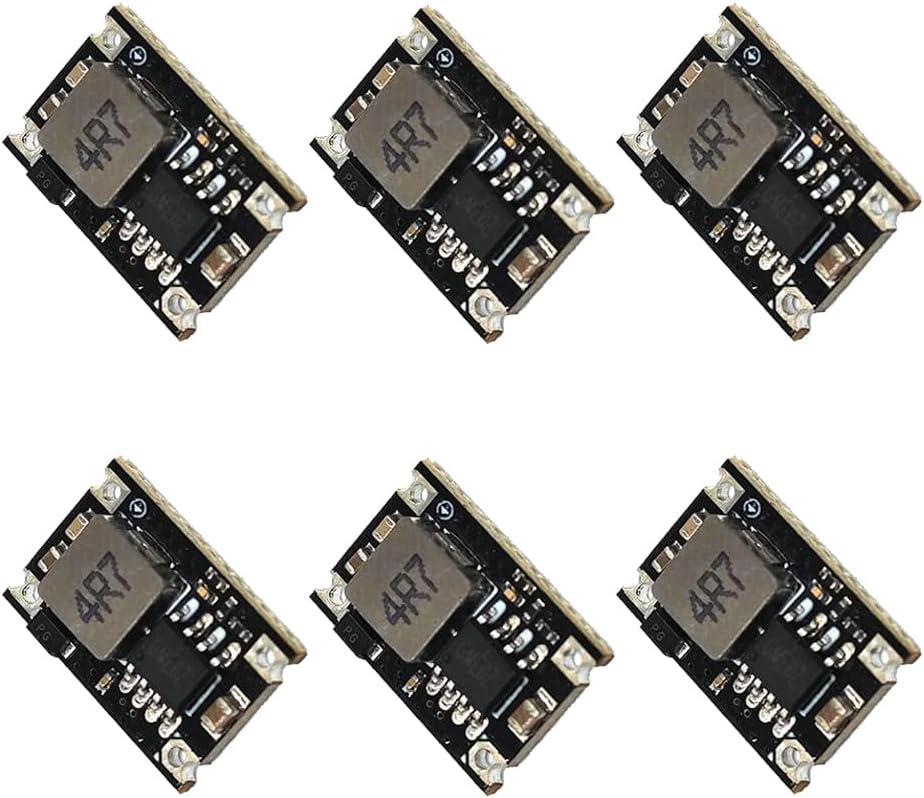
This 6-pack features MP1584EN buck modules with 4.5V to 24V input and 3.3V output up to 1.8A. Its 4.9 rating highlights excellent efficiency and stability.
We may earn a commission when you buy through this link, at no additional cost to you.
Strengths include reaching 1.8A max current and minimal ripple under 30mV. The tiny 17x11x3.6mm size suits aircraft models and tight PCB layouts.
Trade-offs involve adding Zener and capacitors for inductive loads to prevent rear stage chip damage. Soldering requires care due to compact pads.
Recommended for high current demands and space-constrained projects like drones and embedded systems, it offers premium performance. A top choice for reliable power.
Uses the MP1584EN power module known for stable output and efficient switching at 1.5MHz frequency.
Measures 17x11x3.6mm fitting into the smallest spaces while delivering up to 1.8A output.
We may earn a commission when you buy through this link, at no additional cost to you.
This 5-pack converter accepts 1.8V to 5V input and delivers stable 3.3V output at 100mA. Its perfect 5.0 rating confirms excellent performance for low power tasks.
We may earn a commission when you buy through this link, at no additional cost to you.
Strengths include flexible step down or up conversion and compact design ideal for battery operated devices. It ensures 3.3V from varied sources.
Limitations are the 100mA current limit and narrower input range. These are fine for low power sensors but not high draw loads.
Perfect for portable projects needing efficient voltage conversion within 1.8V to 5V, it provides reliable power. Recommended for minimal current applications.
Supports step down or up conversion ensuring 3.3V output from inputs ranging 1.8V to 5V.
Ideal for low power devices needing 100mA stable 3.3V from diverse voltage sources.
We may earn a commission when you buy through this link, at no additional cost to you.
This 5-pack Mini360 module offers 4.5V to 24V input and 3.3V output up to 1.5A with a perfect 5.0 rating. Its tiny size fits dense PCB designs.
We may earn a commission when you buy through this link, at no additional cost to you.
Strengths include reaching 1.5A at 3.2V and ripple under 30mV. The 1MHz to 1.5MHz frequency ensures efficient stable power.
Trade-offs involve adding Zener capacitors for inductive loads and careful soldering. These are minor for most users.
Ideal for compact projects needing high current like Arduino and ESP32, it delivers reliable power. Highly recommended for efficient space-saving designs.
Operates at 1MHz to 1.5MHz ensuring low ripple and stable voltage output under load.
Accepts 4.5V to 24V compatible with 5V 9V 12V and 24V supplies for flexible use.
We may earn a commission when you buy through this link, at no additional cost to you.
This 7-pack features AMS1117-3.3 regulators with 4.75V to 12V input and 3.3V output at 0.8A. It scores 4.2 for consistent linear regulation.
We may earn a commission when you buy through this link, at no additional cost to you.
Strengths include 3-pin design for easy MCU connection and overheat shutdown circuit. Perfect for SCM projects needing reliable 3.3V power.
Limitations are 0.8A max load and heat at higher currents. Suitable for low power but not high current tasks.
Ideal for MSP430 ARM and STM32 boards, it provides constant power. Recommended for budget-friendly linear solutions.
Uses a 3-pin design enabling easy soldering to development boards like Arduino and STM32.
Includes built-in overheat circuit to prevent damage from overload or high temperature.
We may earn a commission when you buy through this link, at no additional cost to you.
This 15-pack offers AMS1117-3.3 regulators with 4.75V to 12V input and 3.3V output at 0.8A. A perfect 5.0 rating confirms excellent reliability.
We may earn a commission when you buy through this link, at no additional cost to you.
Strengths include dynamic voltage difference control minimizing power consumption and built-in overheat overcurrent protection. Ideal for portable battery powered devices.
Limitations are linear design heat and 0.8A max current. Acceptable for low power but not high load.
Recommended for embedded systems and automotive electronics, it provides stable power. A great bulk value for multiple projects.
Maintains stable output with just 1V difference between input and output at full load.
Includes overheat and overcurrent protection preventing chip damage during abnormal conditions.
We may earn a commission when you buy through this link, at no additional cost to you.
This 5-pack offers 5V to 30V input and 3.3V output at 1.8A with a small PCB. It scores 3.4 indicating decent performance but room for improvement.
We may earn a commission when you buy through this link, at no additional cost to you.
Strengths include reverse polarity protection marking and compact design. The 1.5MHz switching ensures stable low ripple output.
Trade-offs include lower rating and basic protection. Suitable for general use but handle inductive loads with care.
Ideal for various applications needing compact buck conversion, it meets daily needs. Recommended for prototyping and general builds.
Includes polarity mark on PCB board to suppress ripple and protect the circuit from miswiring.
Measures 0.67×0.24×0.16 inches fitting easily into tight enclosures and small projects.
We may earn a commission when you buy through this link, at no additional cost to you.
This 5-pack covers 4.5V to 30V input with 3.3V output up to 1.8A. Despite no rating, specs show excellent potential for varied power sources.
We may earn a commission when you buy through this link, at no additional cost to you.
Strengths include ultra-compact size and low ripple at 1.5MHz. Ready for Arduino Raspberry Pi ESP32 and STM32 with minimal setup.
Trade-offs include needing external protection for motors and variable quality. Verify each unit before critical use.
Ideal for vehicle power solar and high voltage applications, it delivers consistent power. Recommended for broad compatibility needs.
Fits wearables drones IoT devices and tight PCB layouts with minimal footprint.
Output ripple under 30mV at 1.5MHz ensures clean stable power for sensitive devices.
We may earn a commission when you buy through this link, at no additional cost to you.
This 10-pack uses AMS1117 with 4.5V to 7V input and 3.3V output at 0.8A. A perfect 5.0 rating confirms stable basic performance.
We may earn a commission when you buy through this link, at no additional cost to you.
Strengths include automatic adjustable boost board start limit voltage feature ensuring safe operation. Ideal for simple 5V source systems.
Limitations are narrow input range and 0.8A max load. Fine for low power but not high voltage.
Perfect for basic low current projects needing reliable 3.3V, it offers value. Recommended for straightforward stepping down applications.
Features automatic adjustable boost board start limit voltage protecting against over voltage damage.
Uses trusted AMS1117 regulator ensuring stable 3.3V output from 4.5V to 7V inputs.
We may earn a commission when you buy through this link, at no additional cost to you.
Selecting the right voltage regulator involves considering several key factors to ensure compatibility and reliability for your specific project needs.
Check the minimum and maximum input voltage your power source provides. Modules supporting wider ranges like 4.5V to 30V offer more flexibility.
Ensure the input range fully covers your supply to avoid dropout or damage during operation.
Verify the module can deliver enough current for your load. Some support up to 1.8A while others cap at 0.8A.
Choose one exceeding your peak current needs to prevent overheating or voltage sag.
Linear regulators are simple but less efficient and generate heat at higher loads. Switching regulators offer better efficiency and lower heat.
Pick based on your efficiency needs and whether heat dissipation is a concern in your design.
Measure available space on your PCB or enclosure. Compact modules fit dense layouts but may be harder to solder.
Ensure the size meets your spatial constraints without compromising performance or heat handling.
Look for built-in protections like overheat shutdown and overcurrent limits. These safeguard your components during fault conditions.
Additional protection like reverse polarity marks or Zener diodes adds safety for inductive loads.
Lower ripple voltage means cleaner power for sensitive electronics. Modules with ripple under 30mV are ideal for microcontrollers and sensors.
Prioritize low ripple to avoid noise interference in your device's operation.
Higher frequencies like 1.5MHz allow smaller components but may generate more electromagnetic interference.
Balance frequency needs with noise requirements in your specific application environment.
Buying packs of 5 to 15 can be cost-effective for prototyping or multiple builds.
Select a quantity that matches your project scale to maximize value.
Connect input voltage within the module's rated range using proper polarity to avoid damage.
Secure the output to your load ensuring wires are tight and solder joints are clean for stable connection.
Add external capacitors and Zener diodes when driving inductive loads like motors to prevent ripple damage.
Linear regulators are simpler and produce less noise but waste energy as heat. Switching regulators are more efficient and handle higher currents but may need external protection.
Yes, many modules accept 4.5V to 24V input. Ensure your regulator supports 5V input specifically to avoid dropout issues.
Heat occurs especially with linear regulators under high load. Use a switching type or add a heatsink to dissipate excess thermal energy safely.
Add external capacitors and Zener diodes across motor terminals to absorb voltage spikes and reduce ripple affecting downstream chips.
Modules with wide input like 4.5V to 30V work best. They handle battery discharge dropping voltage without losing stable output.
Many buck modules support up to 1.8A peak. Continuous output may be lower at higher currents; check thermal limits before relying on full capacity.
The top picks offer reliable 3.3V regulation across varying input levels and current demands for diverse applications.
Prioritize efficiency, size, and protection features based on your specific project requirements and power source type.
Always verify current availability and compatibility before purchasing to ensure your project runs smoothly and safely.