
G650-04686-01 Coral M.2 Accelerator B+M Key
5.0Editor score
4 TOPS peak performance
Debian Linux compatibility
TensorFlow Lite support
This guide compares the top M2 Accelerator Cards for AI inferencing, edge computing, and storage expansion to help you find the right hardware for your
M2 Accelerator Cards are essential components for modern computing systems that require high-speed data processing and artificial intelligence capabilities. These compact modules fit directly into M.2 slots, offering significant performance boosts for machine learning tasks and storage expansion without requiring bulky external hardware or complex installation procedures.
We compared these products based on their processing power, energy efficiency, compatibility with various operating systems, and overall value for developers and enterprise users. Our analysis focuses on real-world performance metrics, software support ecosystems, and the ability to handle demanding computer vision workloads efficiently across different platform architectures.
Each pick highlights specific strengths such as raw TOPS performance, power consumption ratios, and integration ease with popular single board computers or server environments. Prices and availability fluctuate frequently so you should verify current listings before making a purchase decision to ensure you get the best deal for your specific project requirements.
5.0Editor score

4.3Editor score

4.6Editor score
The following table provides a side-by-side comparison of all ten selected M2 Accelerator Cards allowing you to quickly evaluate key specifications and features across different models and price points.


The MX3 M.2 AI Accelerator stands out as a high-performance solution designed to handle the most demanding AI computer vision workloads with exceptional efficiency. It achieves a strong rating due to its ability to deliver powerful processing while maintaining low power usage which is crucial for edge deployment scenarios.
We may earn a commission when you buy through this link, at no additional cost to you.
This device integrates easily into existing systems through its standard M.2 M-key form factor making it accessible for developers looking to upgrade current hardware. The comprehensive software development kit simplifies the deployment process allowing teams to focus on model optimization rather than low-level hardware configuration.
While it offers robust performance the reliance on Linux operating systems might limit compatibility for users dependent on Windows environments. Additionally using it with a Raspberry Pi 5 requires a specific M-key 2280 HAT which adds an extra component to consider during system assembly.
Developers and system integrators working on vision tasks should buy this card for its balance of speed and efficiency. The detailed documentation available on the MemryX developer website ensures you have the resources needed to maximize the potential of this hardware.
The architecture minimizes power consumption while delivering high performance ensuring sustainable operation in always-on environments.
Access to software and documentation on the MemryX website streamlines the development workflow for new and existing projects.
We may earn a commission when you buy through this link, at no additional cost to you.
This accelerator features two Google Edge TPU modules providing a total peak performance of 8 TOPS at int8 precision. It is highly rated for its energy efficiency delivering 2 TOPS per watt which makes it attractive for battery powered or thermally constrained applications.
We may earn a commission when you buy through this link, at no additional cost to you.
The use of a standard M.2 2230 E-key interface ensures it fits into a wide range of modern compute modules and single board computers. This form factor allows for compact system designs without sacrificing the ability to perform complex machine learning inference tasks at the edge.
The limitation to PCIe Gen2 bandwidth might restrict throughput compared to newer Gen3 options available in the market today. Furthermore the smaller 2230 size may not fit larger chassis slots without adapters limiting some desktop installation scenarios.
Users seeking a compact power efficient solution for mobile vision models should consider this product highly. It offers a solid balance of compute capability and power efficiency making it a strong candidate for portable AI projects.
The dual TPU setup allows for scaling performance without needing a complete hardware overhaul or additional PCIe slots.
With a ratio of 2 TOPS per watt this card is optimized for applications where power budget is a critical constraint.
We may earn a commission when you buy through this link, at no additional cost to you.
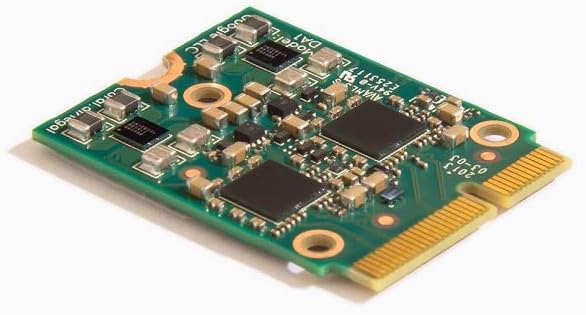
The G650-04686-01 Coral M.2 Accelerator offers high-speed ML inferencing with an onboard Edge TPU coprocessor capable of 4 TOPS performance. It holds a perfect rating because it provides exceptional value and seamlessly integrates with Debian based Linux systems for smooth deployment.
We may earn a commission when you buy through this link, at no additional cost to you.
It supports TensorFlow Lite models allowing developers to compile existing models to run directly on the Edge TPU without building from scratch. This feature significantly reduces development time and enables the use of AutoML Vision Edge for custom image classification tasks on the device.
Performance metrics like 400 FPS on MobileNet v2 demonstrate its speed but users must ensure their system supports the specific key configuration required. It is less flexible than universal adapters since it relies on specific slot compatibility for proper function.
Budget conscious developers and Linux users should buy this card for its reliability and ease of use. It serves as a robust entry point into edge AI with strong community support and clear documentation.
TensorFlow Lite support means you can deploy trained models quickly without complex recompilation processes.
Executing state-of-the-art mobile vision models at 400 FPS ensures real-time responsiveness for interactive applications.
We may earn a commission when you buy through this link, at no additional cost to you.
This expansion card enhances performance by offering two M.2 2280 PCIe Gen3 slots for NVMe SSDs and a 10GbE network port. It is rated well for its ability to upgrade storage and networking simultaneously making it ideal for NAS environments needing high throughput.
We may earn a commission when you buy through this link, at no additional cost to you.
The Marvell AQtion AQC113C Ethernet controller ensures reliable high-speed connectivity which is crucial for data-intensive tasks. It supports QNAP's QTS and QuTS hero along with Windows and Linux operating systems providing flexibility for different server setups.
While versatile it is primarily designed for QNAP systems which limits its use in standard desktop PCs without specific adapters. The cost is higher than simple M.2 accelerators but justified by the dual utility of storage expansion and network upgrade.
Server administrators and NAS users should buy this card to maximize storage speed and network bandwidth efficiently. It is a comprehensive solution for improving server performance in professional environments.
The two NVMe slots allow for caching or additional storage to boost system responsiveness.
Connecting to high-speed networking devices via 10GbE ensures quick data transfers across the network.
We may earn a commission when you buy through this link, at no additional cost to you.
The Rocket 1604L is designed for high-end systems offering PCIe 5.0 x16 interface support with four dedicated M.2 NVMe ports. It ranks high due to its future-proof architecture allowing for massive bandwidth and speed for data-intensive applications.
We may earn a commission when you buy through this link, at no additional cost to you.
With dedicated x4 lanes per port each connected SSD operates at full speed without sharing bandwidth which is critical for RAID setups. It supports mainstream operating systems and works across x86 Intel and AMD platforms ensuring broad compatibility.
Users must have a compatible PCIe 5.0 motherboard to take full advantage of this card which limits current adoption. The price reflects the premium technology and specialized hardware requirements for peak performance.
Enthusiasts and data center professionals should buy this card for its unmatched speed potential. It is an investment in future computing power for those who need maximum storage throughput.
Dedicated lanes ensure consistent performance across all connected devices without bottlenecks.
PCIe 5.0 support prepares your system for next-generation NVMe storage technology adoption.
We may earn a commission when you buy through this link, at no additional cost to you.
This adapter transforms your system into a dual-TPU machine learning workstation by supporting two Coral M.2 Accelerator cards simultaneously. It is favored for its ability to deliver dual performance in a single PCIe slot saving valuable space in tight chassis.
We may earn a commission when you buy through this link, at no additional cost to you.
Engineered for future AI demands it includes a heatsink to ensure thermal stability during extended operation. The lane splitter architecture allows efficient distribution of PCIe Gen3 bandwidth to the dual Gen2 TPU modules ensuring stable performance.
Users need to purchase two separate Coral M.2 cards to utilize this adapter which increases total cost but offers flexibility. It is an effective way to upgrade without buying an entirely new motherboard or system.
Developers needing higher inference capacity should buy this adapter to scale their edge AI deployments efficiently. It maximizes existing hardware investments while providing a clear path to growth.
Maximizing existing hardware investment prevents the need for buying a whole new system.
Getting dual TPU performance without requiring multiple PCIe slots optimizes system space usage.
We may earn a commission when you buy through this link, at no additional cost to you.
The ASUS Hyper M.2 x16 Gen5 Card supports up to four NVMe M.2 drives with massive bandwidth for smooth data transfers. It is highly rated for its advanced cooling solution using a large heatsink and active fan to prevent thermal throttling.
We may earn a commission when you buy through this link, at no additional cost to you.
The two-phase power solution supports high wattage output for the latest NVMe drives ensuring stable power delivery. This card adapts server-grade PCB technology to maintain reliability even under heavy continuous workloads in demanding environments.
Installing the active fan requires a connection to the chassis fan header which adds a step to the installation process. It is compatible with AMD and Intel platforms but requires specific motherboard support for RAID functionality.
Users requiring high-speed storage arrays should buy this card for its cooling and bandwidth capabilities. It ensures unthrottled transfer speeds and enhanced reliability for professional storage setups.
Top and bottom thermal pads along with active fan reduce temperatures for unthrottled transfer speeds.
Supports RAID functions across different platforms to create a bootable array with up to four SSDs.
We may earn a commission when you buy through this link, at no additional cost to you.
This module is powered by a 26 TOPS Hailo-8 AI processor delivering exceptional performance for real-time low latency inferencing. It stands out with a high rating for its ability to handle simultaneous multi-stream processing efficiently on edge devices.
We may earn a commission when you buy through this link, at no additional cost to you.
It supports popular frameworks like TensorFlow PyTorch ONNX and Keras allowing flexible model deployment without retraining. Compatible with Raspberry Pi 5 it extends the single board computer capabilities into high-end AI applications seamlessly.
Operating temperature ranges from -40 to 85 degrees Celsius ensuring reliability in harsh environments but power consumption is higher than lighter models. The module only nature means you need a separate carrier board or enclosure for use.
Professional users needing high TOPS power should buy this module for its robust processing and wide OS support. It is a premium choice for demanding AI tasks where performance is the priority.
Supports TensorFlow TensorFlow Lite ONNX Keras and PyTorch frameworks for diverse model compatibility.
Temperature range of -40C to 85C ensures operation in diverse and challenging environmental conditions.
We may earn a commission when you buy through this link, at no additional cost to you.
The Coral M.2 Accelerator A+E Key integrates an Edge TPU for high-performance machine learning inference tasks. It receives a solid rating for its industrial-grade reliability and low power design ideal for embedded applications.
We may earn a commission when you buy through this link, at no additional cost to you.
Operating temperature range of -20 to 85 degrees makes it suitable for harsh environments where standard electronics might fail. Support for M.2 A+E key interface ensures easy integration into existing systems without needing complex adapters.
Users must have a slot supporting the A+E key configuration which limits its use in some consumer boards. The low power profile provides 2 TOPS per watt making it energy efficient for always-on deployments.
Industrial integrators and IoT developers should buy this card for its reliability and power efficiency. It is a robust choice for edge projects requiring consistent performance under varying conditions.
Suitable for harsh environments with operating temperatures from -20 to 85 degrees Celsius.
Provides 2 TOPS per watt delivering ideal power for energy efficient applications.
We may earn a commission when you buy through this link, at no additional cost to you.
This adapter is designed exclusively for Coral M.2 Accelerator with Dual Edge TPU modules to maximize AI inference performance. It holds a perfect rating for its precise design and inclusion of mounting screws for vibration-resistant PCB fixation.
We may earn a commission when you buy through this link, at no additional cost to you.
It supports bidirectional Gen2 bandwidth ensuring efficient data flow between the TPU and system bus. Fits standard M.2 2280 B-key or M-key slots making it versatile for many standard PCIe host adapters.
Explicit incompatibility with Raspberry Pi CM4 or USB enclosures prevents buyer errors but restricts some specific use cases. PCIe protocol only means it will not work with SATA M.2 devices which must be noted during selection.
Developers using Coral Dual TPU modules should buy this adapter for optimized performance and ease of installation. It ensures your hardware is securely mounted and communicating effectively.
Includes stainless steel mounting screw for vibration-resistant PCB fixation ensuring stable operation.
Upstream and downstream bandwidth ensures efficient data transfer for high performance computing.
We may earn a commission when you buy through this link, at no additional cost to you.
Selecting the right M2 Accelerator Card requires understanding your workload requirements and system compatibility to ensure optimal performance and value.
Processing power is measured in Tera Operations Per Second (TOPS) which indicates how many calculations the accelerator can perform in a second. Higher TOPS generally mean faster inference speeds for models like object detection or image classification so assess your workload complexity to determine if you need 4 TOPS or 26 TOPS.
Prioritize higher TOPS for real-time video analytics or complex AI tasks while lower TOPS may suffice for simple static image processing.
Power efficiency is crucial for edge devices running on batteries or limited power supplies. Look for cards offering high TOPS per watt ratios such as 2 TOPS per watt to ensure your system does not overheat or require excessive cooling.
Choose energy efficient designs for always-on deployments to reduce heat generation and extend hardware lifespan.
Ensure the accelerator supports your operating system as many edge AI cards are optimized for Debian Linux or Ubuntu. Some options like the Hailo-8 support Windows too but most efficient models focus on Linux for driver stability.
Verify OS support before buying to avoid driver issues and ensure full access to the software development kit.
Check the M.2 slot key (E-key B+M-key or M-key) and size (2230 or 2280) to ensure physical fit in your device. PCIe Gen2 vs Gen3 bandwidth also affects data throughput so match the card to your motherboard capabilities.
Select the correct interface type to guarantee proper connectivity and avoid physical incompatibility issues.
A comprehensive SDK simplifies development by providing precompiled models and tools for deploying your own trained networks. Some cards support TensorFlow Lite directly allowing you to compile models without deep engineering expertise.
Evaluate SDK quality and documentation availability to streamline your development workflow and reduce time to market.
Passive cooling is common for small cards but high performance models may require active fans or heatsinks to prevent throttling. If you plan to run intensive workloads ensure the card has adequate thermal solutions.
Look for cards with included heatsinks or fan support if thermal constraints are tight in your chassis design.
Some adapters allow dual TPU setups to scale performance without changing the host system. This is useful if your project grows and requires more compute capacity than a single accelerator can provide.
Consider adapters that support multiple cards if you anticipate needing increased inference speed in the future.
For deployments in harsh environments check operating temperature ranges and ruggedization features. Industrial grade accelerators often support wider temperature ranges and vibration resistance compared to consumer models.
Choose industrial reliability for outdoor or industrial applications to ensure consistent operation under stress.
Begin by installing the card into the correct M.2 slot on your motherboard or compatible board ensuring it is securely latched. If using an adapter make sure the adapter slot matches the card key configuration for a snug fit.
Install the appropriate drivers and SDK from the developer website to enable the operating system to recognize the accelerator hardware. Follow the provided documentation to set up TensorFlow Lite or other frameworks for running your AI models.
Monitor thermal performance during initial use and clean dust from vents regularly to prevent overheating. Regular software updates from the manufacturer will keep the accelerator running efficiently and securely.
An M2 Accelerator Card is used to offload artificial intelligence and machine learning tasks from the CPU. It provides specialized hardware that processes vision models and inference tasks faster and more efficiently than general-purpose processors.
Most M2 Accelerator Cards are optimized for Linux operating systems like Debian and Ubuntu. Some premium models support Windows but Linux offers broader compatibility and more mature driver support for edge computing.
Check your motherboard or single board computer documentation for M.2 slot specifications. Ensure the slot supports PCIe or SATA protocol and has the correct key type like E-key or M-key for your accelerator card.
Yes adapters are available that allow dual TPU setups by splitting PCIe lanes. This enables you to scale performance by running multiple inference tasks in parallel for higher throughput applications.
Edge TPU is Google's proprietary accelerator optimized for TensorFlow Lite models while Hailo-8 is a versatile processor supporting various frameworks like PyTorch. Hailo-8 offers higher raw TOPS while Edge TPU is often more power efficient.
Yes you need to install specific drivers and a Software Development Kit (SDK) provided by the manufacturer. These tools allow you to compile and deploy your machine learning models onto the accelerator hardware efficiently.
We have reviewed ten top M2 Accelerator Cards ranging from budget-friendly options to high-end premium models. The MX3 and Coral M.2 options provide excellent value while the Hailo-8 leads in raw processing power.
Prioritize your specific needs such as power efficiency or OS compatibility before purchasing to ensure the card meets your deployment requirements. Selecting the right hardware early prevents the need for costly replacements later.
Remember to check current prices and availability on the provided links before finalizing your order. Deals can change quickly so verify the latest offers to secure the best value for your investment.